
Activation of automated external defibrillators in the Buenos Aires subway: experience of a public cardioprotection program
pp. 220-224
DOI:
https://doi.org/10.7775/rac.es.v94.i3.21009Keywords:
Out-of-hospital cardiac arrest; automated external defibrillator; public defibrillation; cardiopulmonary resuscitation; public transportAbstract
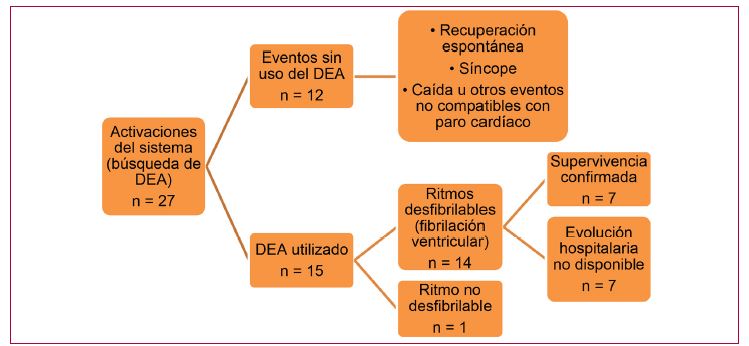
Out-of-hospital sudden cardiac death constitutes one of the main causes of cardiovascular mortality worldwide. Early defibrillation is the most important determinant of survival in patients with shockable rhythms, particularly ventricular fibrillation. Therefore, multiple international guidelines recommend implementing public defibrillation programs in spaces with high circulation of people. The objective of this study was to describe the activations of the response system and the use of automated external defibrillators in the Buenos Aires subway system following the implementation of a cardioprotection program. A descriptive observational study was conducted based on operational records of the program between 2018 and 2024. All occasions in which system personnel went to retrieve an AED for events potentially compatible with cardiac arrest were analyzed. During the analyzed period, 27 system activations were recorded. In 15 cases, the AED was placed on the patient and analyzed the heart rhythm. In 12 cases, the process was interrupted due to recovery of consciousness or identification of events not compatible with cardiac arrest. Among the analyzed cases, 14 shockable rhythms and 1 non-shockable rhythm were identified. Survival was confirmed in 7 patients. These results suggest that the program allowed response
Downloads
Published
Issue
Section
License
Copyright (c) 2026 Argentine Journal of Cardiology

This work is licensed under a Creative Commons Attribution-NonCommercial-ShareAlike 4.0 International License.





