Myocardial Perfusion Defects with Tc 99 Mibi-Spect in Pediatric Patients with Kawasaki's Disease and Left Coronary Anomaly Implantation
pp 301-314
DOI:
https://doi.org/10.7775/rac.v66i3.3466Keywords:
Pediatric myocardial perfusion, Sestamibi, Spect, Ischaemia, Necrosis, Left coronary anomaly implantation, Kawasaki's diseaseAbstract
Several works have been published to study the usefulness of myocardial perfusion in pediatric patients with left coronary anomaly implantation and Kawasaki's disease. Up to date the utilization of Thallium 201 was the rule. The usage of Sestamibi with Spect, has not been described very often even in normal children. This radiopharmaceutical gives better images with lesser radiation and cost than Thallium. It could be useful in the study of patients with left coronary anomaly implantation and Kawasaki's disease, to decide surgery orto evaluate its results. Our objetives were: 1. To study the myocardial perfusion with Sestamibi and Spect in patients with Kawasaki's disease and left coronary anomaly implantation, surgically corrected or not.2. To correlate the findings of myocardial perfusion with clinical electrocardiography, echocardiography and angiographic data. 3.To de termine the sensitivity and specificity of the method comparing with a normal poblation on rest and stress /rest studies.
Material and method
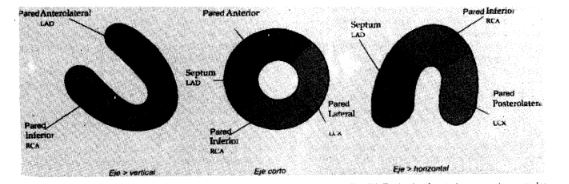
We studied 8 patients with left coronary anomaly implantations, 12 with Kawasaki's disease and 18considered normal. Myocardial perfusion with Sestamibi and Spect was performed on rest and with stress: ergometric (treadmill) or farmacologic (dypiridamol). The tomographic slices were divided in17 segments per study, evaluating the concentration of the radiopharmaceutical in a semiquantitative manner, comparing them to adjacent segments.
Results and conclusions
1. The evaluation of the presence of necrosis and/or ischaemia in the pre-operated and in the postoperated stage with stress/rest (ergometric or pharmacologic) is useful for the diagnostic and follow up of patients with left coronary anomaly implantations. 2. The methodology is simple, with high sensitivity (87%) and specificity (100%) for patients with left coronary anomaly implantations, when it compares with a group of normal patients. 3. The sensitivity of the Kawasaki's disease group is 100%, considering only those patients with alterations of the lumen of coronary arteries in the echocardiography studies, and 60% of the total group. The perfusion gives complementary information of the clinical manifestations and other diagnostic techniques. 4. The evidence of improvement in myocardial perfusion with stress in patients after surgery, with good clinical outcome, could indicate persistence of collateral circulation.
Downloads
Published
Issue
Section
License
Copyright (c) 2026 Argentine Journal of Cardiology

This work is licensed under a Creative Commons Attribution-NonCommercial-ShareAlike 4.0 International License.