
Aortic insufficiency cuantification by Echo Doppler
pp 214-221
DOI:
https://doi.org/10.7775/rac.v58i5.3386Abstract
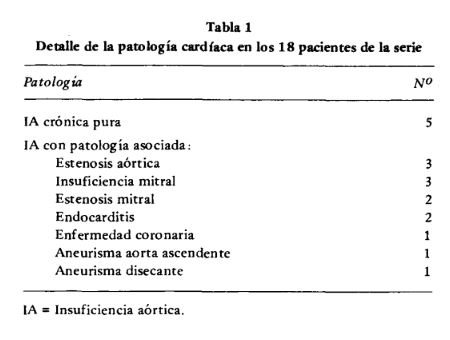
The goal of this study was to assess: 1) the usefulness of Doppler to quantify the aortic insufficiency (AI); 2) the reliability of this method to estimate the left ventricular end diastolic pressure (L VEDP) and 3) the influence of mitral disease on the velocity pattern of the regurgitant flow (RF). Method: Eighteen patients with AI assigned to cath were studied prospectively. Six patients had pure chronic AI, 2 aortic aneurysms, 1 coronary disease, 2 endocarditis, 3 associated aortic stenosis, 2 mitral stenosis (MS) and 2 mitral regurgitation (MR). The following parameters were assessed: RF mapping, deceleration slope (DS) of the RF, pressure haZr time (P1I2T) of the RF, holodiastolic reverse flow into the aorta (HRAo), peak velocity of the atrial component of the mitral flow ("a" Vel) and Doppler LVEDP. Four grades of severity were considered (I to IV). Results: 1) there was a good correlation between Doppler mapping and angiography (r = 0.73); 2) AI grades I-II were separated from III-IV through the DS (p < 0.05) and even better through the P1I2T (p < 0.001); 3) the limit was 3.50 m/s2 for DS and 350 ms for P1/2T; 4) only the ratio P1/2T / mapping grade separated each of the four groups; 5) Doppler PFDVI did not correlate with cath and overestimated it; 6) "a" Vel decreased in AI III-IV, and it is equal to zero in the most severe patients; 7) only AI III-IV had HRAo; 8) in AI IIl-IV DS was very low when associated to MS, and very high with coexisting MR. Conclusions: 1) Doppler is able to separate severe from mild to moderate AI; 2) the best parameters are P1/2T and mapping, and even better is the ratio P1/2T / mapping grade; 3) Doppler has a trend to overestimate the L VEDP; 4) "a" Vel decreases in severe AI; 5) HRAo, unregarded his velocity, is a sign of severity; 6) MS might reduce DS, and MR might increase it.
Downloads
Published
Issue
Section
License
Copyright (c) 2026 Argentine Journal of Cardiology

This work is licensed under a Creative Commons Attribution-NonCommercial-ShareAlike 4.0 International License.





