
Coronary transluminal angioplasty: immediate and long-term outcomes. Experience at the Buenos Aires Cardiovascular Institute
pp 137-143
DOI:
https://doi.org/10.7775/rac.v59i3.3204Abstract
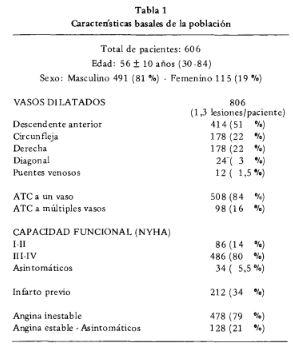
Between January 1985 to December 1988, 606 consecutive patients were treated with percutaneous transluminal coronary angioplasty. Unstable angina was present in 79 % of patients. In 80 % of the cases the sintomatology was severe (functional class HI-IV). Primary success of angioplasty was 91 '10 and mortality was 0.8 %. Acute myocardial infarction associated with the procedure was found in 1.7 % of patients. We obtained a 2 years follow up in 97.7 % of patients. In this period, the event free survival was 88.7 %. Twenty six percent of patients had recurrence of typical angina. In 66 % of the reestenosis was found. A close relation between recurrence of simptoms or ischemia and the etiology was recognized as follows: during the first month it was due to incomplete revascularization; between first to thirth month, reestenosis was present in most of the cases; after sixth month reestenosis -was rare, and progression of coronary heart disease was the most frequent finding. Half of the patients with reestenosis returned with angina functional class III-IV, while most of the patients with incomplete revascularization of progression of coronary heart disease had functional class I-II angina (86 % and 75 % respectively). Our results shows that angioplasty is a very good procedure in selectives subsets of patients with high rate of primary success and two year survival, although we should considere the posibility of a new angioplasty in about 20'10 of the cases in the first months of follow up.
Downloads
Published
Issue
Section
License
Copyright (c) 2026 Argentine Journal of Cardiology

This work is licensed under a Creative Commons Attribution-NonCommercial-ShareAlike 4.0 International License.





