
Screening of high-risk patients following acute myocardial infarction using a 2-D echocardiogram with dobutamine
pp 62-72
DOI:
https://doi.org/10.7775/rac.v61i1.3175Abstract
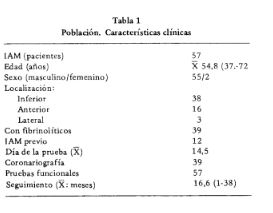
To assess the efficacy of two dimensional echocardiography (Echo 2-D) during dobutamine infusion after acute myocardial infarction, we evaluated 55 men and 2 women, before hospital discharge (X 14.5 day) to detect high risk patients. The patients underwent 2-D echo under basal conditions and during the drug infusion; the dosis ranged from 5 to a maximum of 40 pg/kg/min (8 stages of 3' each). Images were analysed by using an 11 segment left ventricular model. The pharmacological stress test was considered positive if a new and transient wall motion abnormality was observed in remote areas that of infarction. In all cases the results were compared with those obtained in other fuctional tests such as: exercise radionuclide ventriculography (53 patients), exercise thallium 201scintigraphy (5 patients), high dose dipiridamole echo-cardiography (30 patients). 39 patients were also subjected to coronary angiography. There was a follow-up for an average of 16.6 months with the intention of detecting cardiac events (angina, reinfarction, revascularization, death).During dobutamine infusion 29 patients (49%) developed an ischemic response, all the 2-D echo recordings were adequate and-no major adverse reactions occurred. Only two cases presented hypotension, one patient hypertension, four patients supraventricular tachycardia and ten patients had premature ventricular complexes (one short episode of four beats of ventricular tachycardia). In all these cases the side effects promptly resolved spontaneously or by discontinuation the infusion. In 21of 28 patients with multivessel disease new wall motion abnormalities were identified in the segments corresponding to another arterial lesion different from the culprit vessel (sentivity 75 %). In 7 of 11with one vessel disease, no a synergy was observed beyond the 85 % sensitivity and 81 % specificity were found for the infarct zone (specificity 64%). The overall accuracy of dobutamine stress echo was72 '/for assessing significant envolvement of two by three coronary arteries. From a comparison with nuclear medicine studies a85 % sensitivity and 81 "/. specificity were found for the detection of residual ischemia. After discharge 24 events were diagnosed, 18 with a positive dobutamine test (five angina, one death twelve revascularizations) and six with a negative Echo-2D (two recurrent infarctions, three angina, one coronary revascularization). The five patients with a positive test at a low dobutamine dosis (c20 mg/kg/min) were the most severely ill showing multivessel disease, a worse evolution including the only death that occurred during follow-up. Thus, the dobutamine echo stress test proved to have a 75 °i% sensitivity a 70°i.* specificity and a 64% positivite predictive value for detecting cardiac complications.Echo-2D combined with dobutamine infusion is a safe feasible, and well tolerated method for the detection of ischemia. A positive test identifies the patient with multivessel disease and with a higher risk after discharge.
Downloads
Published
Issue
Section
License
Copyright (c) 2026 Argentine Journal of Cardiology

This work is licensed under a Creative Commons Attribution-NonCommercial-ShareAlike 4.0 International License.





