
Secondary Prevention with Statins. Certainties, Controversies and Expectations
pp 315-324
DOI:
https://doi.org/10.7775/rac.v69i3.3070Keywords:
Secondary prevention, Statins, Ongoing trials, Coronary eventsAbstract
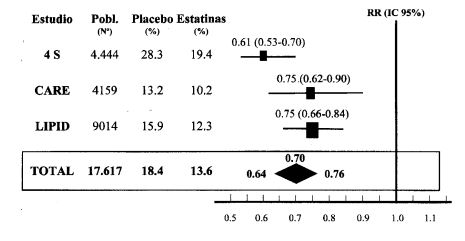
Statins have shown to be of great benefit in patients with a history of coronary heart disease, with additive effects to other therapeutic interventions. In the metanalysis of the studies 4S, CARE and LIPID a 30% reduction in the risk of cardiovascular death or non-fatal myocardial infarction has been observed in a broad spectrum of patients with high or average LDL-C levels. Observational studies and subgroups analysis recently reported suggest that the utilization of statins should be expanded to patients with sub-clinical atherosclerosis or compromise of non-coronary territories, early in the set-ting of an acute coronary syndrome, in elderly patients and diabetics with coronary heart disease. The discussion about the best effective LDL-C target under treatment is still opened. Probably, there is an inverse relationship between the estimated vascular risk and the most "protective" LDL-C level, with a clear reduction of the benefit below the 120-mg/dl level. Data of ongoing clinical trials will clarify some unanswered questions: Do statins have a class effector a drug effect? How low should LDL-C be and in which clinical situations the cost/benefit ratio gives a positive value? Should statins be routinely indicated in all the acute coronary syndromes? Do diabetics need an adjunctive therapy with fibrates? IsLDL-C target level close to 100 mg/dl in intermediate risk patients? Does it have to be below this level in patients with acute coronary syndrome, high-risk chronic coronary heart disease and post coronary artery bypass graft to provide a clear clinical benefit? Time will bring the answers.
Downloads
Published
Issue
Section
License
Copyright (c) 2026 Argentine Journal of Cardiology

This work is licensed under a Creative Commons Attribution-NonCommercial-ShareAlike 4.0 International License.





