
Doppler-echocardiography assessment of systolic anddiastolic function in patients with complete left bundlebranch block
pp 131-137
DOI:
https://doi.org/10.7775/rac.v72i2.2859Keywords:
Echocardiography, Doppler, Ventricular function, Bundle branch blockAbstract
Objective: The purpose of this study was to describe Doppler-echocardiography assessment of left bundle branch block(LBBB) induced modifications on the systolic and diastolicfunction of the left ventricle (LV).
Research design and methods: The control group (group 1) comprised 20 normal subjects.The study group comprised 53 patients with LBBB; 20 male.The latter group was additionally divided into two groups:one with preserved LV function (group 2: 28 p), and one withim paired LV function (group 3: 25 p). The LV ejection fraction (EF) was visually assessed by two independent observers; the systolic excursion of the mitral annulus (SEMA) was measured by means of M-mode. Diastolic function was assessed by means of mitral flow pulsed Doppler, pulsed tissueDoppler and color M–mode propagation velocity (pV). Systodiastolic function was assessed by means of the Tei index.
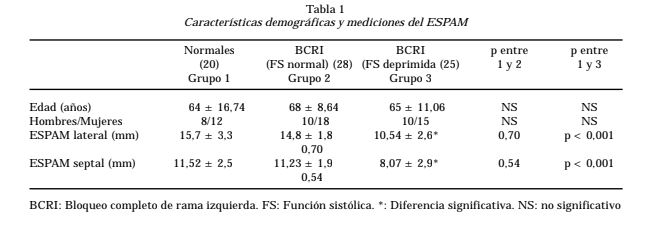
Results: Interobserver variability occurred in 4/53 echocardiographic estimation of left ventricular ejection fraction, (7.19%; kappa= 0.84; CI 95% 0.70-0.99; p<0.001). Patients with preserved systolic function had normal SEMA while those with impaired LV function had abnormal SEMA (Table 1). Diastolic function was abnormal in most LBBB patients. TEI index was also abnormal in most LBBB patients (Table 2).
Conclusions: The systolic function may be assessed in LBBB patients by means of SEMA. Diastolic function was found to be altered in most LBBB patients. We found limited usage of the Tei index in this group of patients.
Downloads
Published
Issue
Section
License
Copyright (c) 2026 Argentine Journal of Cardiology

This work is licensed under a Creative Commons Attribution-NonCommercial-ShareAlike 4.0 International License.





