Comparison Between Two Methods of Endings Assistance with Intra-Aortic Balloon
pp 282-289
DOI:
https://doi.org/10.7775/rac.v70i4.2774Keywords:
counterpulsation balloon , weaning , ventricular assistanceAbstract
Introduction
There are not studies coparing different techniques of ending counterpulsation balloon assistance.
Objective
To assess two weaning techniques of counterpulsation, considering primary success and success relative to the time of usage.
Material and methods
Population
Patients who underwent cardiac surgery with the use of perioperatory counterpulsation balloon between 10-1-98 and 12-1-00 were included. Previous to weaning six hours of hemodynamic stability were required, based on the following criteria; medial arterial pressure of 60 mm Hg or higher, systolic arterial pressure of 90 mm Hg or higher, urinary output above 0.5 ml/kg, cardiac output above 2.5 l/min/m2, peripheral resistance less than 1500 dynes and capillary pressure less than 18 mm Hg.
Weaning Techniques
Frequency variation consisted in loering the number of beats assited from 1:1 through 1:2 and 1:4 with 2 hour period between each situation. If stability was maintained the balloon was withdrawn. Argumentation Reduction: With 1:1 assistance, the augmentation was reduced in 25%, in two sequential phases. If stability was achieved the balloon was withdrawn. Primary success was defined as success in the first attempt of weaning. Those patients who needed urgent withdrawal for complications were excluded, as those requiring ventricular assistance (DA VI). Ap values less than 0.05 was considered significant.
Results
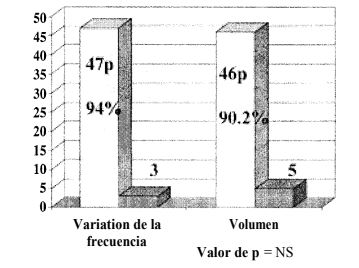
A total of 903 patients were included, 141 received counterpulsation balloon (15.6%). The time of the practice was. Preoperatory in 57 cases (40.4%), Intraoperatory in 66 patients ( 46.8%) and Postoperatory in 18 patients (12.8%) The total mortality was 36 patients (25.5%); 7 deaths in preoperatory procedure (12.3%), 23 deaths (34.8%) in the intraoperatory procedure, and 6 (33.3%) in the postoperatory procedure. In 101 patients the waning was planned (71.6%), in 51 with reduction in volume augmentation (50.4%) while in 50 (49.6%) frequency variation was used. In the population of 51 patients submitted to weaning under reduction of volume, primary success was achieved in 46 cases (90.2%), while in the 50 weaned under frequency variation it was reached in 47 patients (94%). In 3 patients the balloon was withdrawn urgently (2.1 %) and another one was transferred to ventricular assistance. The preoperatory use showed better results with less mortality (12.3%-7 patients) and more weaning (87. 7%-59 patients) than the intra and post-operatory use.
Conclusions
There were no differences between the two considered techniques, showing a high percentage of primary success. The better results were obtained with preoperatory use.
Downloads
Published
Issue
Section
License
Copyright (c) 2026 Argentine Journal of Cardiology

This work is licensed under a Creative Commons Attribution-NonCommercial-ShareAlike 4.0 International License.