
Infectious Endocarditis in Pediatric Patients. Clinical Profile and Surgical Feasibility
pp 275-281
DOI:
https://doi.org/10.7775/rac.v70i4.2773Keywords:
pediatric endocarditis, surgical treatment, vegetations, mortalityAbstract
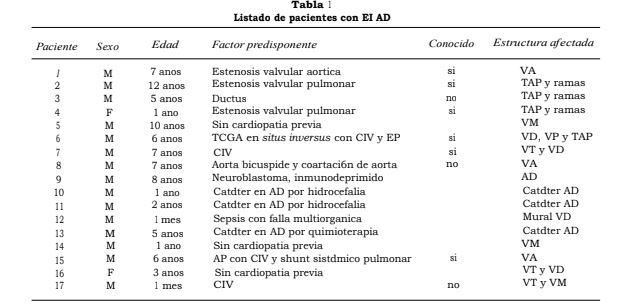
Infectious endocarditis is an uncommon entity in the pediatric population, but it is associated with a high morbimortality rate. Since January 1993 until December 2001 we prospectively evaluated 17 consecutive patients who were diagnosed with definite infectious endocarditis, following Duke's criterions. There was a clear prevalence of males (88.2%). Ages were between 1 month and 12.5 years (average: 5.1 years), 35.3% were younger than 2 years; 58.8% had congenital heart disease and the remaining 41.2% had a heart with a normal structure.
In 70.5% the infection involved the right heart cavities.
The responsible agent was recognized in 64. 7% of the cases, by means ofhemocultive or a tissue culture sample obtained by surgery or necropsy, being Staphylococcus aureus, methicillin-sensitive the most frequent germ (35%).
Echocardiogram was the diagnostic tool allowing visualization of vegetations and intracardiac complications.
Medical treatment with antibiotics-according to the sensivity of the isolated germ- was useful in 7/17 patients (41.1 %). Cardiovascular surgery was indicated in 8 children, 6 of whom suffered a persistent infection for more than 10 days -in spite of a proper antibiotic treatment- and recurrent embolic phenomena with progressive impairment of general state. The remaining 2 were immunosupressed patients with chronic illness and large intracardiac vegetations.
Suspected germ in the cases as Candida albicans and microorganisms of the HACEK group, as it was subsequently confirmed. Persistent fever and large mobile vegetations were determinant factors to suggest surgery. All patients had a clear and immediate improvement after surgery and only residual minor injuries were detected in 25% of the children.
Mortality of the series was 11.7% corresponding to 2 babies of one month of age with severe septicemia and multiorganic failure.
Downloads
Published
Issue
Section
License
Copyright (c) 2026 Argentine Journal of Cardiology

This work is licensed under a Creative Commons Attribution-NonCommercial-ShareAlike 4.0 International License.





