
Type A Symptomatic proximal aortic dissection presentation and outcomes of 138 patients surgically managed (1992-2001)
pp 369-376
DOI:
https://doi.org/10.7775/rac.v70i5.2662Keywords:
Type A Aortic Dissection, Surgery, Aortic rupture, Aortic valve, Thoracic aortic aneurysmAbstract
Objective
To assess the presentation and outcomes of type A aortic dissection (DATA) and to establish predictors of in-hospital and long-term mortality.
Methods
From 2/92 - 5/01, 138 consecutive patients (pts) severely symptomatic with DATA and an undisputed diagnostic test were included. Surgical strategies were valve resuspension with supracoronary aortic root repair and ascending aortic graft in 99 pts (71.7%), composite valve and ascending aortic graft (Bentall or Cabrol operation) in 37 pts (26.8%) ,and M Yacoub technique in two cases (1.4%). Concomitant CABG was performed in 20 pts (14.5%).
Results
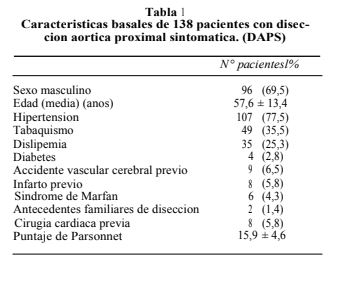
In 106 pts (76.8%) DAPS was acute and in 32 (23.2%) it was chronic. Mean age of patients was 57.6±13.4 years. Chest pain was present in 124 patients (90%) and dyspnoea in 32 (23%). The main surgical complications were: hypoxemia (62.3%), low cardiac output (50%) and renal failure (47.1%). In-hospital mortality was 28.2% (39 patients). Multivariate analysis identified age, previous renal dysfunction, neurovegetative symptoms, days after the onset of symptoms and heart rate > 90 as independent predictors of mortality. Mean follow up was 37.5±29 months. Kaplan Meier estimated (%, CI 95%) survival at 1, 2 and 3 years was 92,7 (87.3-98.5), 91(84.7-97.7) and 79.6 (70-90.5) respectively.
Conclusions
DATA was specially common among hypertensive male patients, with severe chest pain as initial symptom. In-hospital mortality was related to age, previous renal dysfunction, neurovegetative symptoms, days after the onset of symptoms and heart rate at presentation. Long-term survival was good and in accordance to other series.
Downloads
Published
Issue
Section
License
Copyright (c) 2026 Argentine Journal of Cardiology

This work is licensed under a Creative Commons Attribution-NonCommercial-ShareAlike 4.0 International License.





