
Artificial Intelligence Modeling with Non-Invasive Hemodynamics to Predict Preeclampsia in High-Risk Pregnancy
pp. 330-335
DOI:
https://doi.org/10.7775/rac.v91i5.245Abstract
Background: Preeclampsia (PE) is the main cause of maternal-fetal morbidity and mortality in our country. Early hemodynamic changes during pregnancy could predict progression to PE. Machine learning (ML) enables the discovery of hidden patterns that could early detect PE development.
Objective: The aim of this study was to build a classification tree with non-invasive hemodynamic variables for the early prediction
of PE occurrence.
Methods: This was a prospective observational study with high-risk pregnant women (n=1155) referred by the Obstetrics division from January 2016 to October 2022 for ML training sampling, with a j48 classification tree. A total of 112 women with 10 to 16-week pregnancy and without pharmacological treatment were selected, who completed follow-up at the end of their pregnancy. The end point, PE, was a composite of preeclampsia, eclampsia, and HELLP syndrome. They were evaluated simultaneously with impedance cardiography and pulse wave velocity and with 24-h ambulatory blood pressure monitoring (ABPM).
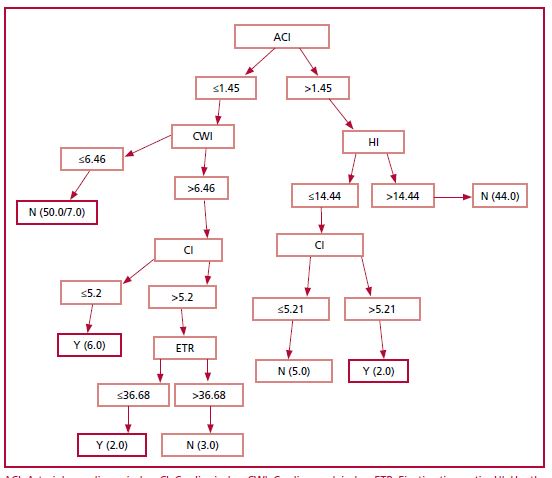
Results: Seventeen patients (15.18%) presented PE. A predictive classification tree was generated with arterial compliance index (ACI), cardiac index (CI), cardiac work index (CWI), ejective time ratio (ETR), and Heather index (HI). A total of 93.75% patients were correctly classified (Kappa 0.70, positive predictive value 0.94 and negative predictive value 0.35; accuracy 0.94, and area under the ROC curve 0.93).
Conclusion: ACI, CI, CWI, ETR and HI variables predicted the early development of PE in our sample with excellent discrimination and accuracy, non-invasively, safely and at low cost.
Keywords: Machine Learning - Preeclampsia - Non-invasive Hemodynamics - Impedance Cardiography
How to cite this article
Olano RD, Espeche W, Leiva Sisnieguez BC, Carrera Ramos PM, Martínez C, Leiva Sisnieguez CE, et al. Artificial Intelligence Modeling with Non-Invasive Hemodynamics to Predict Preeclampsia in High-Risk Pregnancy. Rev Argent Cardiol 2023;91:330-35. http://dx.doi.org/10.7775/rac.v91.i5.20675
Downloads
Published
Issue
Section
License
Copyright (c) 2023 Argentine Journal of Cardiology

This work is licensed under a Creative Commons Attribution-NonCommercial-ShareAlike 4.0 International License.





