
Economic and Financial Crisis in Argentina: A Novel Risk Factor for Cardiovascular Mortality?
pp 137-144
DOI:
https://doi.org/10.7775/rac.v80i2.1904Keywords:
Cardiovascular Diseases, Mortality Rate, Vital Statistics, EpidemiologyAbstract
Background
The relationship between the impact generated by diverse traumatic situations as wars, terrorist attacks and natural disasters with mortality in different regions of the world has been documented in clinical and experimental studies. A recent study showed that, in the absence of natural disasters or wars, financial crises might have a negative impact on cardiovascular mortality. The current experience suggests that financial crises could have a significant influence on health.
Objectives
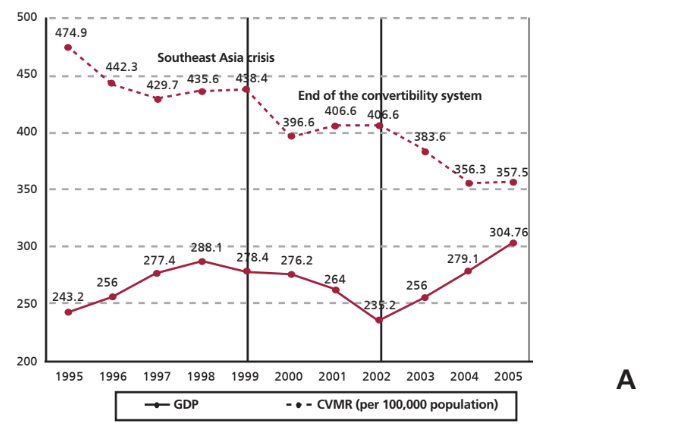
To describe the trends in cardiovascular mortality rates (CVMR) in Argentina between 1995 and 2005, and to explore if there is a close temporal relationship with the changes in trends of the Gross Domestic Product (GDP) as indicator of economic and financial crisis.
Material and Methods
The annual CVMR per 100,000 persons was calculated using the information obtained from the database of the Ministry of Health (9th and 10th International Classification of Diseases). The following causes of death were considered: heart failure (HF), acute myocardial infarction (AMI), chronic coronary artery disease (CAD) and stroke (CVA). The population estimates used as the denominator were obtained from the National Institute of Statistics and Censuses. Two economic crises were identified: the Southeast Asia crisis (1998-1999) and the end of the convertibility system (2001-2002). Join point models were used to evaluate changes in trends.
Results
GDP showed an increasing trend (slope = 17.18) from 1995 to 1998, which decreased in the period 1998-2002 (slope = ‐12.90) and increased from 2002 to 2005 (slope = 19.88); CVMR decreased by 24.72% (from 474.9 to 357.5 per 100,000). The joinpoint model identified three slopes in CVMR: from 1995 to 1997 (‐17.94), a descending slope until 2002 (‐6.8) and an increasing slope until 2005 (slope ‐16.73). Mortality rates due to HF, MI and CVA had a similar trend, decreasing by 22.95%, 16.89% and 38.06%, respectively.
Conclusions
The close temporal relationship between the relative increase in cardiovascular mortality and the reduction of GDP might consider economic and financial crises as a novel psychosocial risk factor.
Downloads
Published
Issue
Section
License
Copyright (c) 2025 Argentine Journal of Cardiology

This work is licensed under a Creative Commons Attribution-NonCommercial-ShareAlike 4.0 International License.





