
Rate-Dependent Bundle Branch Block: Not Only Phase 3 Exists
pp. 245-247
DOI:
https://doi.org/10.7775/rac.es.v81.i3.617Keywords:
Bundle branch block, Bradycardia, Tachycardia, Acute myocardial infarctionAbstract
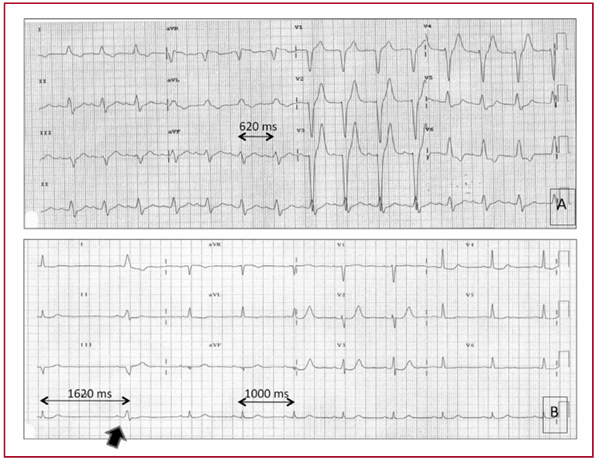
Rate-dependent bundle branch blocks are often related with increased heart rate (tachycardia-dependent or phase-3 bundle branch block). Less often, they are caused by heart rate reduction (bradycardia-dependent or phase-4 bundle branch block). Phase-3 block is the most common type of paroxysmal intraventricular conduction disturbances documented in several publications. However, few articles describe phase-4 bundle branch block, and both mechanisms rarely coexist in the same patient. We report the case of a patient admitted with acute myocardial infarction, presenting with both tachycardia- and bradycardia-dependent paroxysmal intraventricular conduction disturbances.
Downloads
Published
Issue
Section
License
Copyright (c) 2025 Argentine Journal of Cardiology

This work is licensed under a Creative Commons Attribution-NonCommercial-ShareAlike 4.0 International License.





