
Cardiopulmonary Exercise Testing in Healthy Children
pp. 412-417
DOI:
https://doi.org/10.7775/rac.es.v84.i5.8751Keywords:
Exercise Test - Child - Oxygen consumptionAbstract
Background: Cardiopulmonary exercise testing is a valuable tool for assessing the clinical condition and prognosis of patients with cardiovascular disease; it is therefore essential to have normal reference values in healthy children.
Objective: The aim of this study was to perform cardiopulmonary exercise testing in healthy children to obtain reference values in our laboratories.
Methods: Cardiopulmonary exercise testing was performed in 215 healthy children divided into 2 groups: A, Prepubertal and B, Pubertal. These groups were in turn divided into male and female. The test was performed on a treadmill with O2 saturation and breath-by-breath expired gas analysis with a COSMED system. Statistical analysis was performed with SPSS 17 software package.
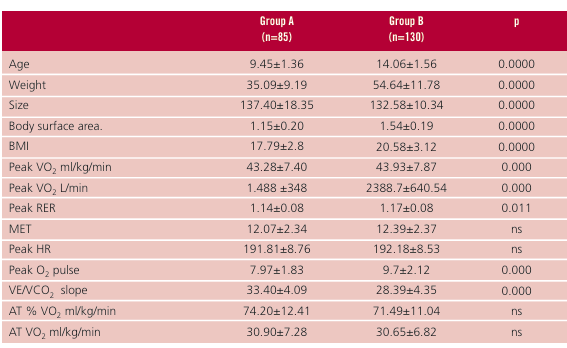
Results: The A and B groups are significantly different in age, weight, height, and body surface area. Significant differences were found between the two groups in VO2ml/min (p <0.0000), respiratory exchange ratio (p <0.01), O2 pulse in ml/bpm (p< 0.0000) and VE/VCO2 slope (p <0.0000). In the analysis by gender there were significant differences in peak VO2ml/kg/min, peak VO2ml/min, MET, VE/VCO2 slope and VO2ml/kg/min in ventilatory anaerobic threshold. Group A also showed significant gender difference in peak heart rate. VO2ml/min and peak O2 pulse (VO2ml/heart rate) increased with age and body surface area. The VE/VCO2 slope decreases with age.
Conclusions: The data obtained in this study allow analysis of cardiopulmonary exercise testing variables in healthy children according to age and gender. These values can be used as reference data to evaluate patients with cardiovascular disease in Argentina.
Downloads
Published
Issue
Section
License
Copyright (c) 2016 Argentine Journal of Cardiology

This work is licensed under a Creative Commons Attribution-NonCommercial-ShareAlike 4.0 International License.





