
Inequalities in the Distribution of Cardiovascular Disease Risk Factors in Argentina. A Study from the 2005, 2009 and 2013 National Risk Factor Survey (NRFS)
pp. 133-139
DOI:
https://doi.org/10.7775/rac.es.v84.i2.8261Keywords:
Risk Factors - Obesity - Hypertension - Smoking - Hypercholesterolemia - InequalitiesAbstract
Background: Cardiovascular health inequalities have been documented in the literature in both developed and undeveloped countries and there is an inverse association between the incidence and mortality for specific cause of cardiovascular disease
and levels of income, education and employment.
Objective: The aim of this study was to identify the existence of inequalities in the prevalence of risk factors by socioeconomic status in Argentina.
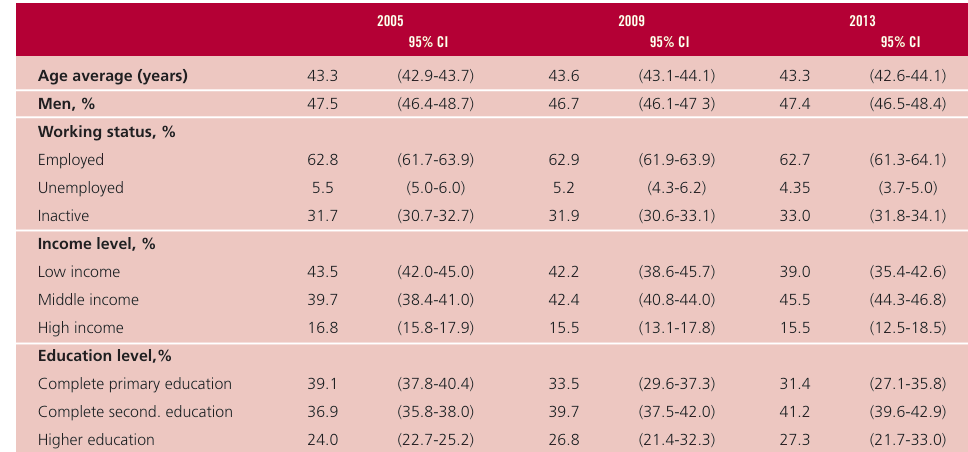
Methods: Data from the 2005, 2009 and 2013 National Risk Factor Surveys (NRFS) were analyzed. The prevalence of obesity, smoking, hypertension and cholesterol were studied. Differences for each risk factor were estimated in relation to socioeconomic status (measured by education, income and health coverage). The independent association between socioeconomic status and risk factors was assessed using logistic regression models.
Results: Educational level was inversely associated with the prevalence of obesity (p<0.01), hypercholesterolemia (p<0.01), hypertension (p<0.01) and smoking (p<0.05) and the effect varied by gender and age group. Income level was significantly and inversely associated with the prevalence of hypertension (p<0.01). The temporal evolution of inequalities indicates there was no attenuation between surveys and, on the contrary, it showed an increase in smoking gaps.
Conclusions: Deep inequalities were recorded in the distribution of cardiovascular risk factors by educational level. Groups with high burden of risk factors are vulnerable populations upon which preventive policies should be targeted.
Downloads
Published
Issue
Section
License
Copyright (c) 2016 Argentine Journal of Cardiology

This work is licensed under a Creative Commons Attribution-NonCommercial-ShareAlike 4.0 International License.





