
Epidemiological Condition of Obesity in Argentina
pp. 126-132
DOI:
https://doi.org/10.7775/rac.es.v84.i2.8028Keywords:
Obesity - Overweight - Epidemiology - Health Inequalities - Public PolicyAbstract
Background: Obesity might be defined as the result of people responding normally to the obesogenic environment they find themselves in.
Objective: The aim of this study was to describe the epidemiological situation of overweight and obesity in adults and adolescents in Argentina.
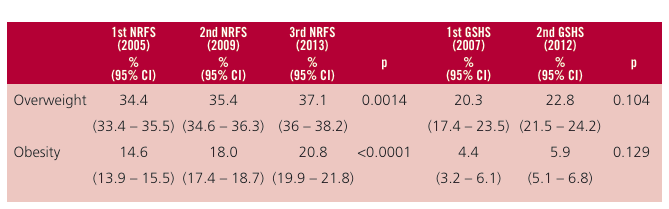
Methods: The prevalence of overweight and obesity and associated factors was estimated in adults and in 13 to 15 year-old students using data from the National Risk Factor Survey (NRFS) of non-communicable diseases and the Global School-based Student Health Survey.
Results: In 2013, the prevalence of overweight (37.1%) and obesity (20.8%) was higher than in previous NRFS. Both indicators were more frequent among males and older people. Level of educational attainment and income were independently associated with a higher prevalence of obesity in women. In 2012, the prevalence of overweight and obesity among adolescents was 22.8% and 5.9%, respectively. Obesity was more frequently observed among students with mothers who had incomplete primary school (8.9% vs. 4.6% in children of mothers with complete high school, p=0.002).
Conclusions: Large-scale multisector actions are needed to stop the growing trend of obesity epidemic. Although evidence is still scarce, strategies to improve dietary habits have been proposed: media and educational campaigns, tax and subsidy strate gies to control food and beverage prices, food labelling and health warnings, regulation of publicity focused on children and adolescents, improvements in workplace and school food environments, reformulation of ultra-processed foods, among others.
Downloads
Published
Issue
Section
License
Copyright (c) 2016 Argentine Journal of Cardiology

This work is licensed under a Creative Commons Attribution-NonCommercial-ShareAlike 4.0 International License.





