
Correspondence of Myocardial Strain with Torrent-Guasp’s Theory. Contributions of New Echocardiographic Parameters
pp 541-549
DOI:
https://doi.org/10.7775/rac.es.v84.i6.9656Keywords:
Echocardiography/methods, Ventricular Function, Left/physiology, Myocardial Contraction/physiologyAbstract
Background: Strain, assessed by speckle tracking echocardiography, may be used to evaluate left ventricular mechanics and could establish reference values together with new indices of myocardial function.
Objective: The aim of this study was to demonstrate the correspondence of echocardiographic strain values with Torrent-Guasp’s single band theory.
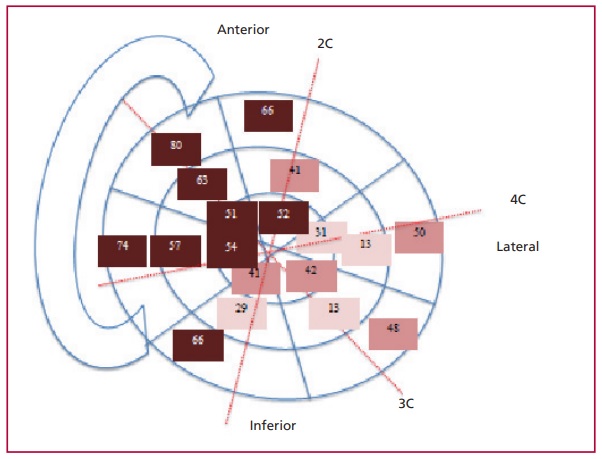
Methods: A prospective observational study was conducted in 54 healthy volunteers. The three apical projections were used to determine longitudinal strain. Radial strain, circumferential strain and rotation were assessed in transverse planes at the level of the mitral valve, the papillary muscles and the apex.
Results: Mean age was 52±10.1 years. Global left ventricular longitudinal strain was -20.8%±2.4%. Post-systolic longitudinal strain mainly affects interventricular septal segments. Radial strain was 36.5%±10.7%, with basal values prevailing over apical ones, extending its duration to the early phase of diastole. Circumferential strain was -20.8%±3.8%, with larger values towards the apex.
Twist was 18.4º±6º, torsion 2.2º±0.8º/cm and the torsion index (twist/mitral annular plane systolic excursion) 13.1º±4.4º/cm. The combined strain index includes the “strain product” (-387º±147º × %), and the “strain index” (-0.9º±0.3º/%) calculated as twist ×longitudinal strain and twist/longitudinal strain, respectively.
Conclusions: New strain parameters may be useful in the study of ventricular mechanics. The anatomical arrangement described by the myocardial band theory is echocardiographically supported by the presence of larger radial strain at the basal-medial level(prevalence of transverse fibers), while the variable arrangement of oblique fibers are responsible for longitudinal strain, circumferential strain and ventricular torsion.
Downloads
Published
Issue
Section
License
Copyright (c) 2025 Argentine Journal of Cardiology

This work is licensed under a Creative Commons Attribution-NonCommercial-ShareAlike 4.0 International License.





