Paroxysmal Atrial Fibrillation: Cryoballoon versus Radiofrequency Catheter Ablation
pp 124-127
DOI:
https://doi.org/10.7775/rac.es.v85.i2.9465Keywords:
Atrial Fibrillation, Cryoablation, RadiofrequencyAbstract
Background: There are few data about which is the best technique for the treatment of paroxysmal atrial fibrillation: radiofrequency
catheter ablation or cryoballoon ablation.
Objective: The aim of this study was to compare immediate and long-term outcomes of irrigated radiofrequency ablation with second-generation cryoballoon ablation.
Methods: This retrospective, observational, single-center study evaluated 159 consecutive patients with paroxysmal atrial fibrillation undergoing pulmonary vein isolation using radiofrequency or cryoballoon ablation. Patient and procedure characteristics, the immediate success rate and the 12-month outcome were assessed.
Results: Among a total of 159 patients, 89 underwent cryoballoon ablation and 70 radiofrequency ablation. Mean follow-up was 12
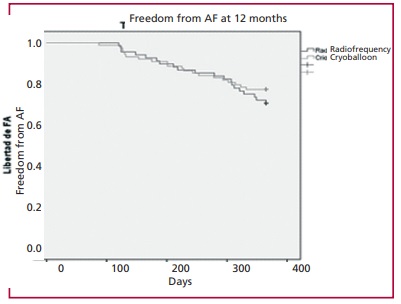
months. There were no significant differences in the population characteristics. The immediate success rate was 97.8% with cryoballoon ablation versus 97.1% with radiofrequency ablation (p=0.8). Freedom from atrial fibrillation at 12 months after a single procedure was 77.5% with cryoballoon versus 71.4% with radiofrequency (p=0.33) ablation. Cryoballoon ablation was associated
with shorter procedure duration compared with radiofrequency ablation (60.19±15 minutes vs. 75.8±31 minutes, respectively; p<0.00001), with shorter left atrial dwell time (45±14 minutes vs. 58±26 minutes; p <0.00001). Fluoroscopy time was significantly higher in the cryoballoon group (18±3.76 minutes vs. 13±2.23 minutes for radiofrequency; p <0.0001). The rate of complications was similar with both procedures (p=0.76).
Conclusion: Compared with irrigated radiofrequency ablation, cryoballoon ablation was associated with shorter procedure time and
similar rate of complications and freedom from atrial fibrillation at 12 months after a single procedure.
Downloads
Published
Issue
Section
License
Copyright (c) 2025 Argentine Journal of Cardiology

This work is licensed under a Creative Commons Attribution-NonCommercial-ShareAlike 4.0 International License.