
Endovascular Treatment of Aortic Aneurysms with Complex Proximal Anatomy
pp. 185-189
DOI:
https://doi.org/10.7775/rac.es.v86.i3.11905Keywords:
Aneurysm - Aortic Aneurysm, Abdominal/surgery - Blood Vessel Prosthesis ImplantationAbstract
Background: There are few publications on patients with juxta or pararenal aneurysms, defined as abdominal aortic aneurysms without a proximal neck suitable for standard endovascular anchoring. We present our experience for their endoluminal repair.
Methods: This was an observational and prospective study. The results were evaluated at 30 days and up to 2 years in patients consecutively treated with fenestrated or chimney endografts.
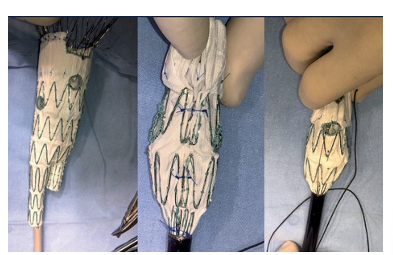
Results: Between July 2015 and July 2017, 21 complex endovascular procedures were performed. Thirteen industrially tailored fenestrated devices and 4 physician-fenestrated devices were implanted. Four patients were treated using the chimney technique. Thirty-three fenestrations (2.5 fenestrations/patient) and 15 chimneys (1.8 stents/patient) were manufactured. Events at 30 days included 4.7% mortality and 9.4% branch occlusions, which were re-permeabilized. Among these patients, 2 presented type I endoleak that was repaired. Mean follow-up time was 15 months. In the 2-year Kaplan-Meier analysis, overall survival was 91.7%; primary blood vessel patency was 85.7% and secondary patency 100%. Type I or type III endoleak-free survival was 91.7% at 1 year, and 81.5% at two years. No mortality associated with the aneurysm or its rupture was recorded during follow-up.
Conclusions: These results show a current, effective and safe option for patients with complex aortic aneurysms, using a minimally invasive tailored approach. Probably, these results have consolidated a more important role of these techniques in the treatment of patients with complex aortic aneurysms.
Downloads
Published
Issue
Section
License
Copyright (c) 2018 Argentine Journal of Cardiology

This work is licensed under a Creative Commons Attribution-NonCommercial-ShareAlike 4.0 International License.





