
Clinical Significance of Impaired Liver Function Tests in Decompensated Heart Failure
210-215
DOI:
https://doi.org/10.7775/rac.es.v85.i3.10288Keywords:
Heart Failure - Liver Function Tests - PrognosisAbstract
Background: Therapeutic progress in chronic heart failure has not been reflected in decompensated patients, compelling the need for new therapeutic and prognostic tools. Although liver function tests are part of routine admission studies, their clinical significance is not clearly established.
Objective: The aim of this study was to evaluate the prognostic relevance of liver function tests in decompensated heart failure.
Methods: The study analyzed the prevalence and in-hospital mortality association of elevated (at least twice the normal value) total bilirubin (TB), alkaline phosphatase (APh) and alanine aminotransferase (ALT) or aspartate aminotransferase (AST) in 700 consecutive patients admitted into two coronary care units due to decompensated heart failure, with liver function tests at admission, and no previous liver disease.
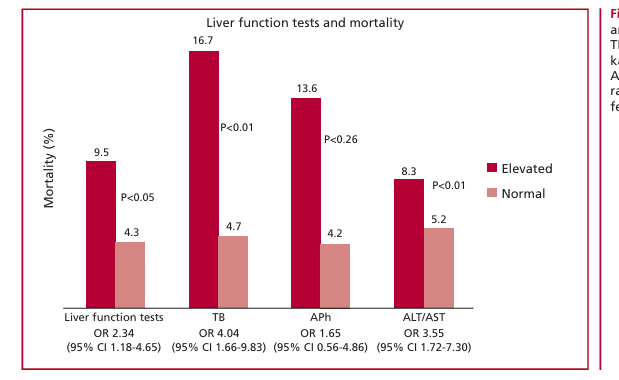
Results: In 20.8% of cases, patients presented some abnormal liver function test: 6%, increased TB, 12.6% increased ALT or AST and 12.6% increased APh. In the univariate analysis [(OR (95% CI)], any abnormal liver function test [2.34 (1.18-4.65)], TB [4.05 (1.66-.83)], ALT/AST [3.56 (1.72-7.34)] but not APh were associated with higher in-hospital mortality. In the multivariate model, cardiogenic shock [9.48 (2.31-38.78)], TB [3.61 (1.29-10.04)], AST/ALT [2.83 (1.28-6.25)], renal failure at admission [3.55 (1.48-8.49)] and history of chronic obstructive pulmonary disease [2.66 (1.21-5.87)] were independently associated with mortality.
Conclusions: Accessible tests such as liver function assessment provide additional prognostic information at admission. In an unselected patient population, abnormal liver function may probably express increased vulnerability rather than he modynamic impairment.
Downloads
Published
Issue
Section
License
Copyright (c) 2017 Argentine Journal of Cardiology

This work is licensed under a Creative Commons Attribution-NonCommercial-ShareAlike 4.0 International License.





