
Atrial Septal Defect Assessed by Cardiovascular Magnetic Resonance: Comparison with Doppler Echocardiography
pp 30-35
DOI:
https://doi.org/10.7775/rac.v75i1.2534Keywords:
Magnetic Resonance Imaging, Echocardiography, Atrial Septal DefectAbstract
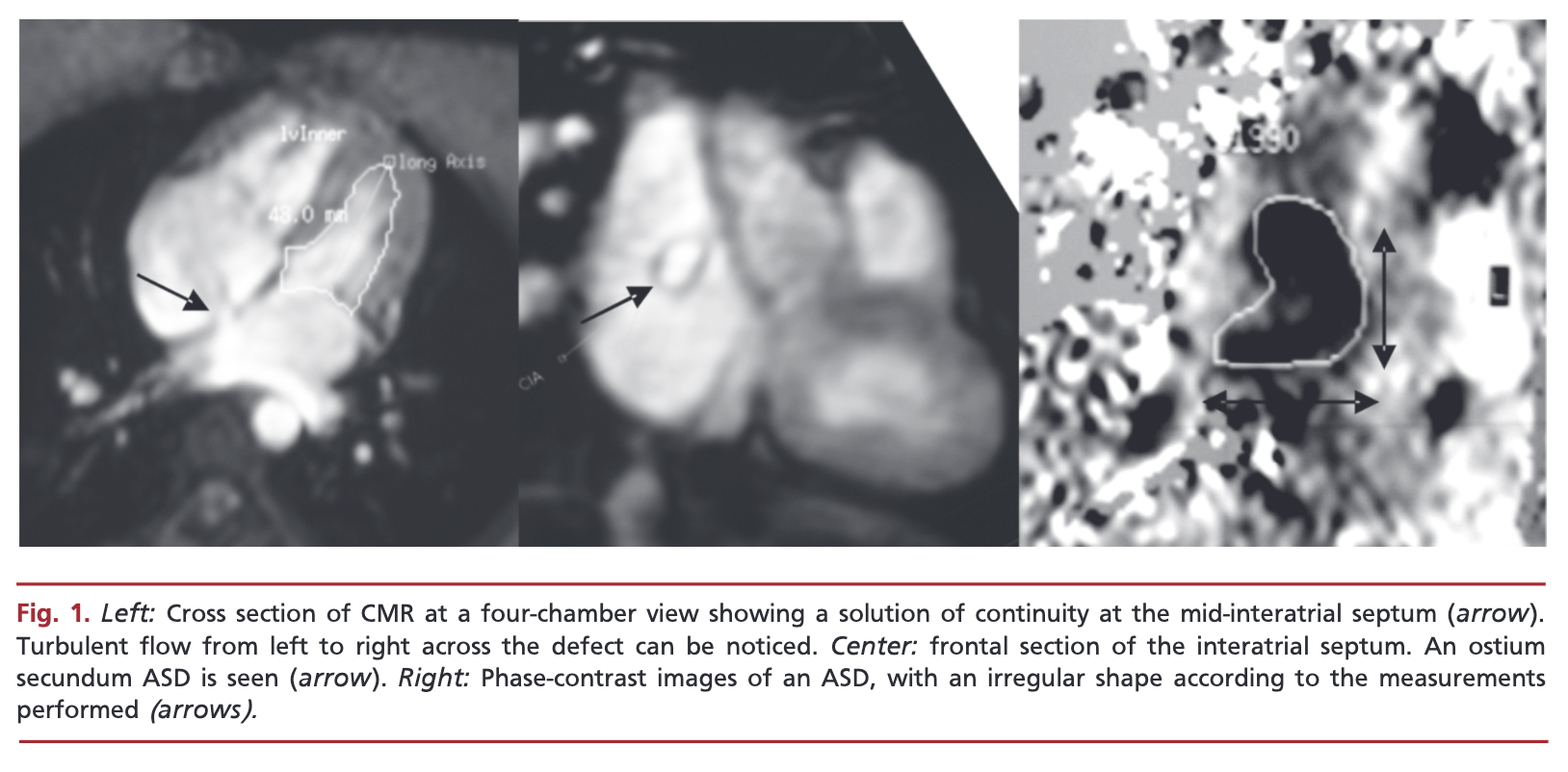
Atrial septal defect (ASD) is one of the most frequent congenital defects diagnosed in adult patients. Doppler echocardiography (DE) is the method of choice for its diagnosis and fol-low-up. Cardiovascular magnetic resonance (CMR), with its multiple applications, may be an excellent alternative for the assessment of this disorder. To analyze the usefulness of CMR in ASD, we evaluated 30 patients with ASD and compared the results with those of DE. Twenty three patients had a ostium secundum type of ASD, 6 had a sinus venous ASD and 1 had an ostium primum ASD. There was good correlation between CMR and DE in the aortic flows (r=0.67, p <0.007), pulmonary flows (r=0.62, p<0.01) and Qp/Qs (r=0.56, p<0.003). The frontal view of the ASD could only be assessed with CMR, which also allowed quantifying the flow through the defect. Direct planimetry of the ASD correlated adequately with quantitative pulmonary flow and the flow through the interatrial defect; additionally, the results obtained with both techniques were confirmed by CMR. We conclude that CMR correlates well with DE and is a valid alternative for the assessment of ASD. The frontal visualization of the defect and its flow quantification represent an advantage of CMR over DE.
Downloads
Published
Issue
Section
License
Copyright (c) 2026 Argentine Journal of Cardiology

This work is licensed under a Creative Commons Attribution-NonCommercial-ShareAlike 4.0 International License.





