Association Between Endothelial Dysfunction Assessed by Ischemic Test with Brachial Echo-Doppler and Von Willebrand Factor in Chagas' Disease
pp 274-280
DOI:
https://doi.org/10.7775/rac.v69i3.3063Keywords:
Chagas' disease, Brachial echo-Doppler, von Willebrand factor, Endothelial impairmentAbstract
Introduction
According to recent published information micro-vascular endothelial changes in Chagas' disease could be related to cardiomyocyte alteration favor-ing disease progression.
Objectives
The aim of the present study was to explore the association between brachial echo-Doppler (BED) and von Willebrand factor (VWF) as possible markers of endothelial alterations in chagasic patients and healthy controls.
Material and methods Fifty-one chagasic patients were enrolled, 33 in an undetermined phase of the disease (18 women, 15men, mean age 35 years old [range 28-39]) and the remaining 18 had been already diagnosed with heart disease (8 women, 10 men, mean age 41.5years old [range 37-451). A population of 12 healthy subjects acted as controls (6 women and 6 men, mean age 38 years old [range 30-45]). Serum samples obtained from cases and controls were specifically tested for Chagas' disease (3 different tests). The whole population was submitted to physical examination, clinical laboratory tests,ECG, chest-X-ray studies, echocardiography andBED (basal, post-compression, and post-nitroglycerine). vWF was also assessed (normal range 0.5-1.5IU/ml). Patients with cardiac risk factors and conditions known to affect vWF levels were excluded.All data were submitted to statistical analysis chisquare test and multiple logistic regression. Results Three main outcome measures deserve special attention: 1) there is an univariate significant association between BED and vWF (r= 0.69,p =0.0000001) and between BED and gender (r= 0.28;p= 0.0297). Ab-normal BED values and altered vWF levels were more frequent among chagasic subjects. Considering BED as the "gold standard", sensitivity and specificity of vWF determination were 83.9% and96.7%, respectively; 2) stepwise analysis of the dis-criminative function revealed that -taking BED as the dependent variable- vWF levels and sex were the only discriminative variables in this model (p<0.01); 3) multiple logistic regression pointed tovWF value as the only independent variable related to endothelial dysfunction -measured by BED-after adjusting the results by age, gender and health status (chagasic patients or healthy controls) with p =0.001. Conclusions vWF was significantly related to BED alteration in chagasic patients in undetermined phase with cardiomyopathy as well as in control subjects.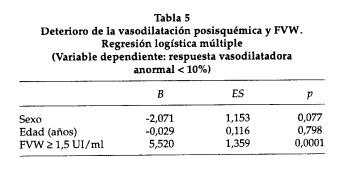
Downloads
Published
2026-03-02
Issue
Section
ORIGINAL ARTICLES
License
Copyright (c) 2026 Argentine Journal of Cardiology

This work is licensed under a Creative Commons Attribution-NonCommercial-ShareAlike 4.0 International License.