http://dx.doi.org/10.7775/rac.v91.i1.20602
OPINION ARTICLE
Is Fluid Dynamics Assessment the New Stage of
Cardiovascular Imaging Diagnosis?
¿Es la evaluación de dinámica de fluidos
la nueva etapa del diagnóstico por imágenes cardiovascular?
Omar PrietoMTSAC,
FACC, FASE, Federico Staricco
Echocardiography, as well as the different cardiac imaging
techniques, has significantly evolved in the last decades.
Ultrasound machines and software continue to amaze us
both in the medical setting as in biomedical engineering.
For a long time we dedicated our attention to the
study of the cardiac structure and its impact on velocities, pressures and
gradients. We were able to assess myocardial deformation and early predict the
involvement of the left ventricular pump function, and numerous scientific
studies were published correlating anatomo-functional
disorders with clinical scenarios.
At present, we have the immense possibility of
evaluating the inverse relationship. That is, what happens to our heart when
fluid dynamics are altered and the energy this generates.
Although this type of evaluations can be performed with 3D resonance imaging,
this is not always available for routine practice. On the other hand, there are
similar methods of intracardiac fluid analysis, but
they require the use of contrast material, are dependent on the angle or can
only be used with transesophageal echocardiography. (1)
Until recently, the evaluation of fluid dynamics with
conventional ultrasound machines was done with spectral and color Doppler
tools. However, these methods present the limitation of velocity analysis only
parallel to the direction of the ultrasound beam, and the rest of the components
of the complex intracavitary flow analysis could not
be evaluated through this modality. (1)
In order to understand this technology, it is useful
to perform a review of some concepts related to fluid dynamics, and vector and
scalar fields.
Upon making a closer evaluation of intracardiac
flows by echocardiographic assessment with transthoracic transducer, we can
incorporate a blood flow vector map and observe that within the cardiac
chamber it runs in more than one direction.
As can be seen in Figure 1, the
blood that passes through the mitral valve to enter the left ventricle
generates a ring of vortices which, if selected and analyzed in the bidimensional plane, show that some rotate in a clockwise
and others in a counterclockwise direction. (1)
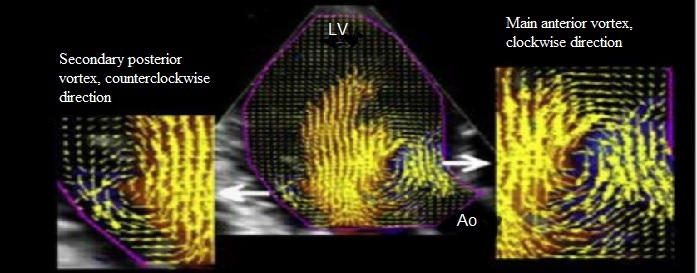
LV: Left ventricle. Ao:
Aorta
Fig. 1. Vector mapping illustrating the different rotational
behavior of anterior and posterior vortices.
In the case described, vortices rotate in a counterclockwise
direction in the space between the posterior leaflet of the mitral valve and
the left ventricular posterior wall. On the other hand, at the left
ventricular outflow tract higher magnitude vortices rotate in a clockwise
direction.
To understand this phenomenon, we believe it is
adequate to define some central concepts
Vortices: physical magnitude used in fluid mechanics to quantify
rotation, given by a rotational vector. (2)
Direction of rotation and angular velocity: If an object is rotating in
two dimensions, it is possible to completely describe the rotation with angular
velocity. A positive angular velocity indicates that the rotation is
counterclockwise, whereas a negative value indicates that the rotation is
clockwise. (2)
However, the situation is somewhat more complex for intracardiac flow. It is necessary to represent both the
angular velocity as the three-dimensional space direction in which the cardiac
flow is rotating. To achieve this, the rotation in three dimensions is normally
described using a rotational vector where both the vortex magnitude and
direction are represented. To evaluate the vortex direction in a simple way,
the “right-hand rule” is used. What does it consist of? The right-hand fingers
are curled in the direction of the rotation and the thumb is extended. The
vector that represents this rotation in three dimensions is, by definition,
oriented in the direction of this finger. (2)
Another important point to consider is how a velocity
vector map is generated. This technique is derived from the use of two modes,
which have been very useful in echocardiographic assessment in the last years:
color Doppler and left ventricular deformation assessment by speckle tracking.
As previously mentioned, color Doppler only provides the velocity parallel to
the ultrasound axes and, on the other hand, it is possible to obtain the
transverse velocities of the left ventricular myocardium by speckle tracking. (3)
This means that blood velocity and trajectory within
the left ventricle can be represented by means of myocardial transverse
velocity vectors as blood flow longitudinal velocity through the color mode.
As seen in Figure 2, another point
to emphasize is that having the information of the flow velocity vectors, it is
also possible to represent through a parametrization
map, the magnitude and direction of vortices generated in a cardiac cycle by
means of a color map. (4) By convention, in this
map, the vortices that rotate in a clockwise direction are represented in blue,
and those that rotate in the opposite direction, in red
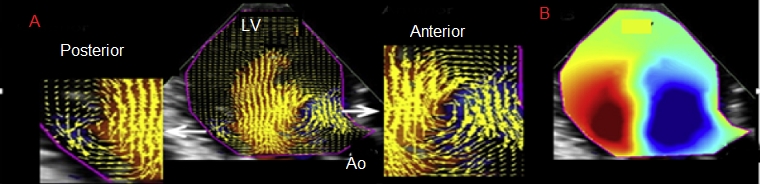
LV: Left ventricle: Ao.
Aorta
Fig. 2. To the left (A),
vortices’ vectorial field map generated in the left
ventricle. To the right (B), vortices’ magnitude and direction parametrization map
In addition, thanks to fluid velocity vectors and
blood density and viscosity values, it is possible to represent a third map of
kinetic energy to study the higher levels of energy generated in the left
ventricle denoted in red. In a healthy patient, the highest levels of energy
directly proportional to velocity variations are in the left ventricular
outflow tract. In dilated cardiomyopathy, the kinetic energy analysis shows
that the highest levels of energy are far from the left ventricular outflow
tract, at the ventricular apical level. Then, by knowing the kinetic energy, it
is possible to assess energy dissipation. This variable has been very useful to
monitor healthy and ill persons, and it has been shown that patients with
dilated cardiomyopathy present lower values of energy loss compared with
healthy individuals (Figure 3). (4)
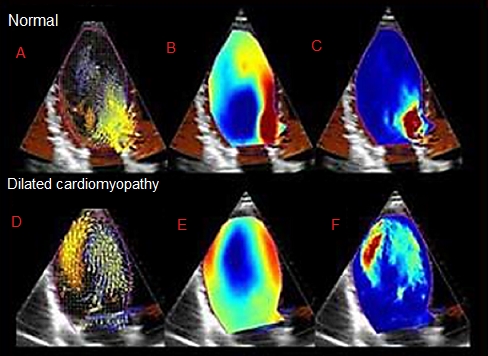
Fig. 3. Panels A and
D exemplify the representation of the flow velocity vector data map, in
which a 2D velocity vector field is represented as overlaid vectors in the
traditional CFM (Color Flow Mode). Panels B and E show a
circulation parametric map, in which vortices are represented as compact
regions colored in blue (clockwise vortex rotation) or red (counterclockwise
vortex rotation): Panels C and F provide representations of
kinetic energy maps
Possibly, the greatest clinical experience with this
technique is in left ventricular systolic function impairment.
An interesting work presented by the group of the
University of Padua led by Dr. Donato Mele could show the differences present in the dynamics of intracavitary flow among healthy individuals and patients
with heart failure. (5) It was seen that the study
was feasible and the differences present in the different evaluation parameters
of intracavitary flow dynamics were reproducible,
therefore providing relevant scientific support to consider it as a highly
useful tool.
The diverse clinical scenarios in which the anatomical
geometry can be affected probably impact on fluid dynamics. An example is
supplied by coronary heart disease and transmural
acute myocardial infarction: here the extent of infarction and left ventricular
systolic function can be considered. Consequently, with this variable, it has
been possible to demonstrate the relationship between the extent of the
ischemic event, regional dysfunction and left ventricular systolic function
with intraventricular turbulence and the fluctuation
and dissipation of kinetic energy, a phenomenon that makes a significant
difference in the analysis and interpretation of the consequences and
implications of these events. (6)
Heart valve disease as well as valve replacement have
also been evaluated with this technology, and changes have been shown in the
sense of vortex rotation in dual-leaflet mechanical valves. The kinetic energy
dissipation parameters are greater in patients with valve replacement compared
with healthy ones. (7)
Cardiac resynchronization therapy (8) hypertrophic cardiomyopathy, (9-11)
atrial fibrillation (12) and the detection of
apical thrombi (6) have also been analyzed with
this technology, which offers a novel aspect in the anatomo-physiological
explanation of cardiovascular disease.
Once again, the association of
technological and cardiology progress demonstrates that joint work defines a
course where the goal is the optimization of patient diagnosis.
Conflicts of interest
None declared.
(See authors' conflict of interests forms on the web/Additional material.)
Ethical considerations
Not applicable.
1. Fiorencis A, Pepe M, Smarrazzo
V, Martini M, Severino S, Pergola V, et al. Noninvasive
Evaluation of Intraventricular Flow Dynamics by the HyperDoppler Technique: First Application to Normal
Subjects, Athletes, and Patients with Heart Failure. J Clin
Med 2022;11:2216. https://doi.org/10.3390/jcm11082216
2. Gettys WE, Keller FJ, Skove
MJ. Física clásica y
moderna. 1era Edición, Mc Graw Hill, Madrid, 1991.
3. Sperlongano S, D'Andrea A, Mele D, Russo V,
Pergola V, Carbone A, et al. Left Ventricular Deformation and Vortex Analysis
in Heart Failure: From Ultrasound Technique to Current Clinical Application.
Diagnostics 2021;11:892. https://doi.org/10.3390/diagnostics11050892
4. Mele D, Smarrazzo
V, Pedrizzetti G, Capasso
F, Pepe M, Severino S, et
al. Intracardiac Flow Analysis: Techniques and
Potential Clinical Applications. J Am Soc Echocardiogr 2019;32:319-32. https://doi.org/10.1016/j.echo.2018.10.018
5. Svalbring E, Fredriksson A, Eriksson J, Dyverfeldt
P, Ebbers T, Bolger AF, et al. Altered diastolic flow
patterns and kinetic energy in subtle left venttricular
remodeling and dysfunction detected by 4D flow MRI. PLoS
One 2016;11:e0161391. https://doi.org/10.1371/journal.pone.0161391
6. Agati L, Cimino
S, Tonti G, Cicogna F, Petronilli
V, Pedrizzetti G. Quantitative analysis of intraventricular blood flow dynamics by echocardiographic
particle image velocimetry in patients with acute
myocardial infarction at different stages of left ventricular dysfunction. Eur Heart J Cardiovasc Imaging
2014;15:1203-12. https://doi.org/10.1093/ehjci/jeu106
7. Faludi R, Szulik
M, D’hooge J, Herijgers P, Rademakers F, Pedrizzetti G, et
al. Left ventricular flow patterns in healthy subjects and patients with
prosthetic mitral valves: an in vivo study using echocardiographic particle
image velocimetry. J Thorac Cardiovasc
Surg 2010;139:1501-10. https://doi.org/10.1016/j.jtcvs.2009.07.060
8. Mele D, Nardozza M, Malagù M, Leonetti E, Fragale C, Rondinella A, et al. Left Ventricular
Lead Position Guided by Parametric Strain Echocardiography Improves Response to
Cardiac Resynchronization Therapy. J Am Soc Echocardiogr 2017;30:1001-11. https://doi.org/10.1016/j.echo.2017.06.012
9. Prinz C, Lehmann R, Brandao
da Silva D, Jurczak B, Bitter T, Faber L, et al.Echocardiographic particle image velocimetry
for the evaluation of diastolic function in hypertrophic nonobstructive
cardiomyopathy. Echocardiography 2014;31:886-9. https://doi.org/10.1111/echo.12487
10. Maragiannis D, Alvarez PA, Schutt RC, Chin K, Buergler JM, Little
SH, et al. Vortex formation time index in patients with hypertrophic
cardiomyopathy. JACC Cardiovasc Imaging 2016;9:1229-31. https://doi.org/10.1016/j.jcmg.2015.10.009
11. Ro R, Halpern D, Sahn JD, Homel P, Arabadjian M, Lopresto C, et al.
Vector flow mapping in obstructive hypertrophic cardiomyopathy to assess the
relationship of early systolic left ventricular flow and the mitral valve. J
Am Coll Cardiol 2014;64:1984-95. https://doi.org/10.1016/j.jacc.2014.04.090
12. Park KH, Son JW,
Park WJ, Lee SH, Kim U, Park JS, et al. Characterization of the left atrial
vortex flow by two-dimensional transesophageal
contrast echocardiography using particle image velocimetry.
Ultrasound Med Biol 2013;39:62-71.
https://doi.org/10.1016/j.
ultrasmedbio.2012.08.013