Hypertriglyceridemia is defined as fasting and postprandial
triglyceride (TG) levels greater than 150 and 175 mg/dL, respectively.
This elevation results from either increased TG production, decreased
catabolism of TG-rich lipoproteins (TRL) or impaired clearance. The
estimated prevalence of hypertriglyceridemia is 25% worldwide. (1)
The role of TG as a risk factor for cardiovascular disease (CVD) has
been the subject of debate within the medical and scientific communities
for many years. (2) The residual atherosclerotic risk, as previously
defined, is attributable to the persistence of atherogenic particles
with apolipoprotein B (ApoB). These particles are not exclusively
present in low-density lipoprotein cholesterol (LDL-C); they are also
found in other very low-density lipoproteins (VLDL),
intermediate-density lipoproteins (IDL), and cholesterol remnants. These
particles are characteristically present in patients with type 2
diabetes, metabolic syndrome and insulin resistance.
The following discussion will present the arguments in favor of
considering TG, expressed as absolute value, non-high-density
lipoprotein cholesterol [total cholesterol (TC) minus high-density
lipoprotein cholesterol (HDL-C)] or cholesterol remnants, as a
significant risk factor for CVD. It will be demonstrated that lowering
TG values contributes to lowering CVD risk. This argument is supported
by recent evidence from epidemiological, genetic, and interventional
studies. (Figure 1). (3,4)
Figure 1:
Triglycerides, remnants and cardiovascular disease
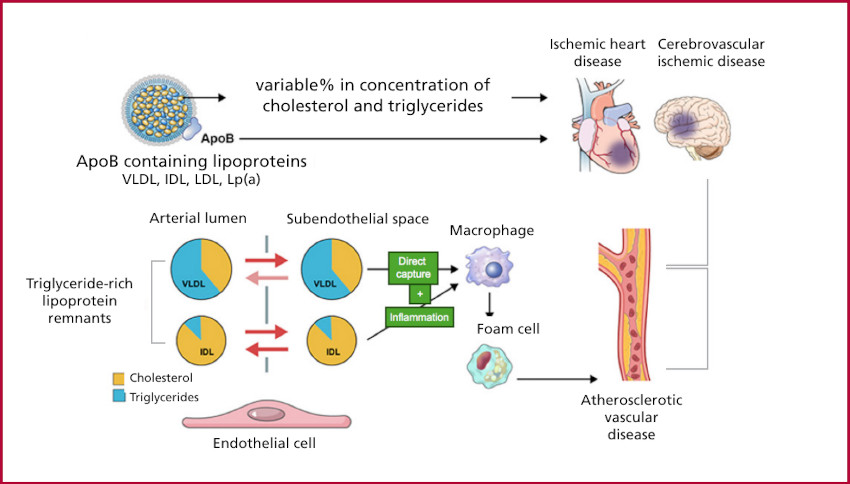
IDL: intermediate-density lipoproteins; LDL: low density
lipoproteins; Lp(a): lipoprotein(a); VLDL: very low density
lipoproteins
Arguments in favor of the role of triglycerides as CVD risk
factor
1. Epidemiological evidence:
Population-based studies: Several observational
studies, including the PREDIMED study and the Copenhagen General
Population Study, have consistently demonstrated a correlation between
elevated TG levels and an increased risk of cardiovascular events (CVE)
such as myocardial infarction and coronary artery disease. (5-7)
Follow-up data: Longitudinal studies have observed
that individuals with hypertriglyceridemia have a higher incidence of
CVE, independently of other risk factors such as LDL-C levels. (8)
2. Biochemical mechanisms:
Atherosclerotic plaque formation: TG contribute to
atherosclerotic plaque formation from their remnants, which are
cholesterol-rich particles that infiltrate the arterial wall,
contributing to the development of atherosclerotic plaques. When these
particles become trapped in the vascular subendothelium, they trigger a
retention process, leading to the generation of atherosclerotic plaque
and subsequent complications, such as rupture. This is the classic
pathophysiological process of atherosclerosis. (9)
Endothelial dysfunction and inflammation: Elevated
TG levels are associated with endothelial dysfunction and with the
production of inflammatory mediators and cytokines within the vascular
subendothelium. These mediators can contribute to the progression of
atherosclerosis. This raises the double effect or impact in terms of
vascular damage derived from these lipoproteins, not only capable of
internalizing in the subendothelium but also of generating local
inflammation that enhances the deleterious mechanism. (9)
3. Genetic and intervention studies:
Mendelian randomization: Studies using the Mendelian
randomization technique have found a causal relationship between genetic
variants that elevate TG levels and an increased risk of CVD. (10)
Intervention clinical trials:
Therapeutic agents for the treatment of elevated TG levels include
statins, fibrates, peroxisome proliferator-activated receptor alpha (PPAR-α), and
omega-3 polyunsaturated fatty acids. Fibrates have the greatest power to
reduce TG (a reduction between 30-50%, depending on baseline plasma
concentrations) and non-HDL cholesterol (between 6-16%). In patients
with severe hypertriglyceridemia, the use of fibrates can lead to an
increase in LDL levels. Eicosapentaenoic acid (EPA) is less effective
than fibrates at reducing TG levels, but it has several other notable
benefits, such as improving vascular endothelial function, inhibiting
platelet aggregation, and having anti-inflammatory properties.
Subgroup analysis of pharmacological interventions to lower TG, such
as fibrates, has been shown to reduce the risk of CVEs in patients with
elevated TG levels. Additionally, the legacy effect, evidenced in the
long-term follow-up of patients who received fenofibrate, shows a clear
benefit with these drugs. (11,12) High-dose omega-3 fatty acids
(specifically EPA), demonstrated a clear benefit on CVD risk in the
REDUCE-IT trial in those patients with high TG levels. The impact on TG
levels is proposed to be one of the mechanisms that explains this
benefit. (13)
Conclusions
While TG have historically been overshadowed by the focus on LDL-C,
the cumulative evidence suggests that they should not be ignored as a
risk factor for CVD and should clearly be taken into account when
assessing atherosclerotic residual risk. TG and their remnants have
direct implications in the pathogenesis of atherosclerotic CVD and their
management could represent an additional therapeutic strategy in the
global effort to combat the epidemic of CVD. However, further research
is needed to optimize treatment strategies and to establish clear
guidelines on the appropriate timing and manner for intervention in
cases of hypertriglyceridemia.
Conflicts of interest
None declared (See author conflicts of interest form on the website)
"To be or not to be—that is the question" is perhaps one of the most
famous quotes in world literature. It is also the opening line of
Hamlet's soliloquy in William Shakespeare's eponymous play. With all the
respect that the play and its author deserve, I will borrow it to argue
my position on this interesting controversy.
The association between lipids, particularly cholesterol, and the
risk of developing CVD began to be robustly established in 1953 with the
publication by Ancel Keys. (1) Since then, the role of cholesterol in
the development of atherosclerotic CVD and the impact of lowering
cholesterol levels, particularly LDL-C, on reducing cardiovascular risk
have been clearly demonstrated. (2)
There is also evidence of the association between TG levels and
increased risk of atherosclerotic CVD. (3,4) However, in my role as an
antagonist in this controversy, it is necessary to analyze why I should
not focus on reducing TG levels to reduce CV risk. I bring up a phrase
that I have heard repeatedly from Dr. Corral, who acts as an agonist in
this debate: "Correlation does not imply causation". Returning to the
opening quote of the text, the key question is: are TGs a causal factor
or simply a marker of cardiovascular risk? This distinction is
fundamental and extends beyond a mere semantic difference. While a
marker allows for identifying those individuals or populations at
greater risk of developing an event (in this case, a CVE), treatment
cannot modify this risk. In contrast, a risk factor is a condition that,
when modified, reduces the chance of an event occurring, thereby
becoming a therapeutic target.
From a physiological point of view, lipids circulate in the
bloodstream bound to proteins, forming particles called lipoproteins,
whose content varies from one particle to another. TG are primarily
transported in particles that originate in the liver (VLDL and IDL) and
in chylomicrons, which originate in the intestine. Although these
particles are rich in TG, it is estimated that they carry approximately
one third of circulating cholesterol (remnant cholesterol), (5) and
their constitutive protein is ApoB, as in LDL-C. (6) Consequently, the
question arises as to whether the increased CV risk observed in patients
with elevated TG levels is directly associated with this elevation
(causation) or with the concomitantly transported cholesterol
(correlation). Although this analysis focuses on lipid particles, the
common factor in atherogenic risk associated with both lipid fractions
seems to be more related to the number of ApoB particles than to the
mass of cholesterol within ApoB particles. (7)
It is also relevant to consider what happens in patients with
extremely high TG values due to genetic alterations in their metabolism.
Although this brief pathophysiological review might suggest that TGs are
not the main cause of the problem, different research groups have
evaluated strategies to reduce cardiovascular risk by lowering TG
levels.
In this context, I will focus on the two most widely used
pharmacological groups for the treatment of mild and moderate
hypertriglyceridemia: fibrates and omega-3 fatty acids.
The most prominent studies on fibrates are the BIP (Bezafibrate
Infarction Prevention) study, (8) the FIELD (Fenofibrate Intervention
and Event Lowering in Diabetes) study (9) and the ACCORD (Action to
Control Cardiovascular Risk in Diabetes) study. (10) In these studies
the use of bezafibrate (BIP) and fenofibrate (FIELD and ACCORD) did not
result in a significant reduction in CVE, despite achieving reductions
in TG levels of 21%, 29% and 25.6%, respectively. However, a
meta-analysis that included 45 048 patients with hypertriglyceridemia
and low HDL-C levels showed significant reductions of 10% in major CVEs
and 13% in coronary events. (11) This suggests that the impact of TG may
have clinical relevance in patients with low HDL-C. It also raises
questions about the adequacy of the populations evaluated in the
aforementioned studies to confirm causation of hypertriglyceridemia in
atherosclerotic disease.
The PROMINENT (Pemafibrate to Reduce Cardiovascular Outcomes by
Reducing Triglycerides in Patients with Diabetes) study was conducted to
answer this question. (12) This trial included patients with diabetes,
plasma TG levels between 200 and 499 mg/dL and HDL-C levels ≤ 40 mg/dL
who were randomly assigned to receive pemafibrate or placebo. Despite a
26.2% reduction in TG levels in the treated group, the incidence of the
primary CV endpoints was not significantly lower. This finding could be
attributed to the increase in ApoB levels observed in the
pemafibrate-treated group, which reopens the debate: "TG or ApoB, that
seems to be the question".
With regard to omega-3 fatty acids, I will voluntarily omit the
GISSI-Prevenzione study. The omission is not due to any personal
convenience in my role as antagonist; rather, the decision is based on
the fact that the baseline treatment used in the study does not align
with the current concept of cardiovascular risk management. (13) The
JELIS (Japan EPA Lipid Intervention Study) deserves to be mentioned in
first place. This study evaluated the use of EPA in subjects with
hypercholesterolemia who were receiving statins and who had mean TG
levels of 154 mg/dL (111 mg/dL - 224 mg/dL). (14) Patients treated with
EPA 1800 mg daily experienced a 19% reduction (p = 0.048) in the
incidence of major coronary events compared with those receiving statins
alone. However, the difference in TG reduction between the two groups
was only 4% (9% vs. 5%), suggesting that this modest decrease alone
would not fully explain the observed benefit. More recently, the
REDUCE-IT study evaluated the use of icosapent ethyl in patients with
CVD or diabetes associated with other risk factors treated with statins,
with TG levels between 135 and 499 mg/dL. (15) Patients treated with 4
g/day of icosapent ethyl had a 25% reduction (HR 0.75, p < 0.001) in
the risk of presenting the composite ischemic events (nonfatal
myocardial infarction, nonfatal stroke, coronary revascularization, or
unstable angina) and CV death, and the risk of the secondary end point
was also lower. Contrary to the findings of the JELIS study, a greater
reduction in TG levels was observed in this case, reaching 18.3%. Is
this 18.3% reduction sufficient to justify the CV benefit? I believe
not, and I support my position with two arguments. First, the STRENGTH
(Study to Assess Statin Residual Risk with Epanova in High
Cardiovascular Risk Patients with Hypertriglyceridemia) trial, which
evaluated a combination of EPA with docosahexaenoic acid (DHA) in a
similar population, found no reduction in CVD despite a reduction in TG
levels that was virtually identical to that reported in the REDUCE-IT
trial. (16) Second, in the REDUCE-IT trial subgroup analysis, the
benefit was similar in patients with baseline TG levels < 150 mg/dL
versus those with levels ≥ 150 mg/dL, or < 200 mg/dL versus ≥ 200
mg/dL. Additionally, TG levels at one year after randomization were not
predictive of CV benefit. The study was favorable even in the subgroup
of patients with TG levels < 150 mg/dL, (17) suggesting that other
mechanisms may be responsible for the CV benefit observed in the
REDUCE-IT study. (18)
Considering the aforementioned points, it can be concluded that
lowering TG levels should not be considered a primary strategy for
reducing CV risk. In this context, hypertriglyceridemia should be
regarded as a risk marker rather than a therapeutic target, given its
association with elevated levels of remnant cholesterol and ApoB-rich
particles, which appear to be the primary contributors to the observed
increase in CV risk. Therefore, the therapeutic approach should focus on
reducing ApoB-rich particles.
Furthermore, certain treatments, such as icosapent ethyl, could offer
an alternative approach due to their pleiotropic effects that extend
beyond the mere reduction of TG levels.
To conclude, I would like to reiterate and adapt to the context the
famous phrase from Hamlet with which I began this post of this
controversy: "To be or not to be a lipid fraction causative of
atherosclerosis, that is the question."
Conflicts of interest
None declared (See author conflicts of interest form on the website)
AGONIST REPLY
First, I would like to express my gratitude to my friend, Dr. Augusto
Lavalle Cobo, for facilitating this exchange and for his clear
exposition and review of the available evidence, primarily from
pharmacological intervention studies.
However, I must point out that if it is suggested that TG levels
should not be measured and treated, neither non-HDL-C nor ApoB (which is
recommended in all national and international guidelines) should be used
as a therapeutic target. This is because the representation of blood TG
levels is provided by the remnant TG-rich particles containing ApoB, and
these particles have the dual capacity to cause damage, infiltrate the
subendothelium, and create an inflammatory phenomenon that speeds up and
enhances the development of atherosclerosis.
Despite what has been previously mentioned, we must understand and
re-examine the physiology and pathophysiology of lipids, wherein LDL
particles emerge as a consequence of the catabolism and degradation of
VLDLs secreted by the liver. This continuous metabolic process (from
VLDL, traversing IDL, culminating in LDL) is distinctive and linear, and
the presence of elevated TG levels clearly evidences increased
cardiovascular risk.
In my daily practice, I ask myself: why would I order determination
of ApoB or estimation of non-HDL-C in a patient? The answer to this
question is simple: because that patient has elevated TG levels,
residual risk attributable to TRL and cholesterol remnants, and it has
been demonstrated that, in that context, measuring LDL-C alone is not
sufficient for risk assessment (in my patient with TG levels of 70
mg/dL, measuring ApoB or calculating non-HDL-C does not provide more
information for management).
In conclusion and referring to the initial point of the controversy
(lowering TG to reduce cardiovascular risk), it is crucial to
acknowledge that TGs are not merely a "marker" of CV risk (as are, for
example, troponin T or NT-proBNP). The futility observed in various
pharmacological studies conducted to date should not make us ignore the
fact that my patient, with TG levels of 300 mg/dL, should be "treated",
which is not the same as "medicated", because they have an evident risk
with interventions (diet, exercise, future ApoC3 inhibitors?) that can
modify this biomarker and improve cardiovascular prognosis.
Pablo Corral
It is a pleasure to share this controversy with Dr. Pablo Corral,
with whom, in addition to a great interest in lipids, I have a deep
friendship. I congratulate Dr. Corral for the clear and precise
explanation offered during his intervention as a proponent of the
agonist position in this controversy. In his presentation, he highlights
the evidence from various types of studies demonstrating the
relationship between elevated TG levels and increased risk of
atherosclerotic cardiovascular events.
As the saying goes: "Tell me who you hang out with and I will tell
you who you are". In this regard, it is noteworthy to mention that TG,
as previously indicated, circulate in the bloodstream in particles that
contain ApoB as a constituent protein. In most of these particles, TG
are associated with other lipid fractions, such as cholesterol, which
justifies measuring ApoB or estimating non-HDL-C to assess an
individual's residual lipid risk.
Personally, when I see a patient with moderate hypertriglyceridemia,
I ask myself the following question: should I focus on lowering TG or be
more aggressive in lowering ApoB? After all that has been said, you can
probably imagine my approach.
I would like to conclude with a reflection that may seem obvious, but
which is always important to emphasize when we talk about cardiovascular
risk: the necessity of a comprehensive approach. This is even more
relevant when we refer to hypertriglyceridemia, since, in many cases,
this condition reflects a poor "cardiometabolic" state. In such cases,
lifestyle interventions (e.g., weight control, improved diet, and
increased physical activity) have been shown to not only positively
impact cardiovascular risk but also reduce plasma TG levels.
Augusto Lavalle Cobo

