A un siglo del Premio Nobel de Willem Einthoven (1860-1927) y el desarrollo de la electrocardiografía

Rev Argent Cardiol 2024;92:312-315. http://dx.doi.org/10.7775/rac.es.v92.i4.20801
Correspondence: Camila Ampuero Acuña. E-mail: camila.ampuero.a@gmail.com

One hundred years after the Nobel Prize in Physiology or Medicine was awarded to Willem Einthoven (1860-1927) for his invention of the string galvanometer, now known as the electrocardiograph, it remains the most commonly used cardiovascular laboratory diagnostic tool for the evaluation of cardiac conduction disorders and ischemic heart disease because it is reliable, noninvasive and inexpensive.
The following is a review of the life of this remarkable Dutch physician and physiologist, and a review of part of the history of the electrocardiograph, which concluded with the definitive establishment of the device and the birth of clinical electrocardiography.
The electrical activity of the human heart was first recorded at the end of the 19th century by the British physiologist August Desiré Waller (1856-1922). During the month of May 1887, at St. Mary's Hospital, in the central London neighborhood of Paddington, he obtained a recording (then called an electrogram) using thoracic surface electrodes and a capillary electrometer, a device previously developed in 1873 by the French physicist Gabriel Lippmann (1845-1921). (1) The tracing was rudimentary and poor in detail, due to the inertia of mercury, and showed only two deflections, ventricular depolarization and repolarization. Waller was not very confident of its usefulness; even much later (1911) he remarked: "I do not think that electrocardiography will have any practical application in a hospital... It will be used sparingly, or occasionally in the case where a rare abnormality of the cardiac pulse has to be recorded." (2)
However, it is widely believed that modern electrocardiography was born with the Dutch physician and physiologist Willem Einthoven (1860-1927) (Figure 1).
Fig 1.
Portrait of Willem Einthoven, professor of physiology and histology at the University of Leiden (1926). Author: Albertus Jan Marinus van Dijk (1892-1967).
At:https://commons.wikimedia.org/wiki/File:Portrait_of_W._(Willem)_Einthoven,_professor_of_Physiology_and_Histology_at_Leiden_University_Icones_332.tiff. Public domain)
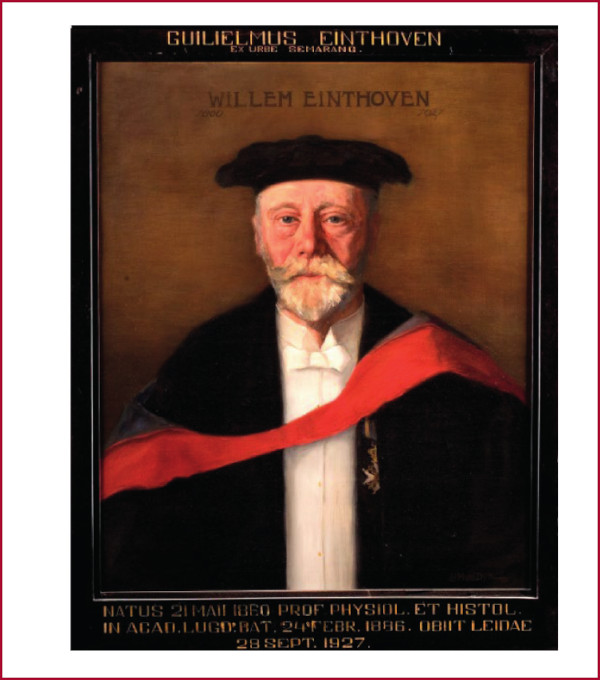
Einthoven was born on May 21, 1860 in the city of Semarang, on the island of Java, currently belonging to Indonesia. He was the third of six children of the second marriage of Jacob Einthoven, with Louise Marie Mathilde Caroline de Vogel. When his father died, Willem was only six years old. Four years later, in 1870, he and his family settled in the city of Utrecht, Holland. (3)
The young Einthoven tried to follow his father's footsteps, and entered the University of Utrecht in 1878 as a medical student. Like his father, he was also financed by the army on the condition that after finishing his studies he would work as a military doctor in the colonies. During his years of study, Einthoven stood out as a great sportsman (gymnast, fencer and rower) and a strong promoter of physical education, as well as being the founder of the Utrecht student rowing club and the Olympic Gymnastics and Fencing Society. He received his medical degree in 1885, and while he was preparing to honor his word and thus return to Java as an ophthalmologist, an unexpected event occurred. Only one year after graduating, the chair of physiology at the prestigious Leiden University, the oldest of the Dutch universities, became vacant. Thanks to the support of his mentor, Dr. Donders, who had persuaded the University Council, he was appointed to the position in February 1886, and held it until his death. Thanks to the salary he began to receive, he was able to pay the guarantee to the army (6000 guilders), and after freeing himself from the commitment to return to Java he was able to devote fully to research. Soon after, he married his first cousin Frédérique Jeanne Louise de Vogel, with whom he had four children. (2,3)
Under Einthoven's direction, the laboratory progressively became a world-renowned reference center. Between 1885 and 1889 Einthoven's research was linked to optics and respiratory physiology, exploring topics such as intrapleural and intrathoracic pressures and the pathophysiology of asthma (he described the role of the vagus nerve). But in 1889 Einthoven attended the International Congress of Physiology held in Basel (Switzerland), where he had the opportunity to witness Waller's new experiments with the capillary electrometer. From then on, his interests were directed towards the electrophysiology of the heart, for which he endeavored to design a device that could measure more precisely and at the same time record cardiac electrical impulses, an interest that accompanied him throughout his life. In this laboratory, at the beginning of the 20th century, always supported by his assistant Van de Woerd (since it is pointed out that he was particularly clumsy in terms of manual dexterity), an essential and everlasting diagnostic tool emerged.
Dissatisfied with the inaccurate recordings he obtained with Lippmann's capillary electrometer, despite having made mathematical corrections and significant improvements, he began work on a new technical solution for a more sensitive galvanometer, an instrument he called the "string galvanometer". Einthoven made his findings known to the scientific world (although he gave credit to Waller's earlier work) in several publications, one of which was published in 1895 as Ueber die Form des menschlichen Electrocardiograms. It was here that the term electrocardiogram appeared, but it is noted that Einthoven attributed it to Waller as a mark of respect for his colleague. (4)
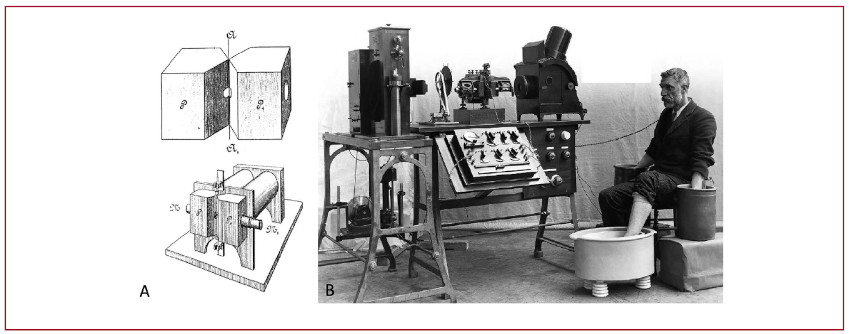
In early 1901, he published his preliminary work Un noveau galvanomѐtre, (5) where he described this new instrument in greater detail, comparing the records obtained with those of the capillary electrometer. The string galvanometer, he explained, "consists of a thin silver-coated quartz filament conducting electric current and stretched like a string in a magnetic field As soon as the current passes through it, the filament moves from its perpendicular equilibrium position to the direction of the lines of magnetic force, revealing a movement which can be observed and photographed by means of a considerable magnification; ... thus being possible to regulate very accurately the sensitivity of the galvanometer within wide limits by tightening or loosening the string” (Figure 2A).
Fig. 2
A. Principle of the string galvanometer, according to Einthoven's 1906 article "Le Télécardiogramme" B. Electrocardiograph used by Lewis, built by the Cambridge Scientific Instrument Company of London in 1911.
A (At https://commons.wikimedia.org/wiki/File:Einthoven%27s_string_galvanometer.jpg . Public domain)
B (At a target="xrefwindow" href="https://en.wikipedia.org/wiki/Image:Willem_Einthoven_ECG.jpg">https://en.wikipedia.org/wiki/Image:Willem_Einthoven_ECG.jpg. Public domain )
In 1903, he published Galvanometric recording of the human electrocardiogram, with a review of the capillary electrometer in physiology thus achieving a great impact on the scientific community, since it was on this occasion that he analyzed the two types of tracings obtained, providing a more detailed description, depending on whether the string galvanometer or the capillary electrometer was used. (Figure 3).
Fig. 3
Waves obtained by A.D. Waller (top); waves obtained by Einthoven with his improved capillary electrometer (center); electrocardiographic tracing using the string galvanometer (bottom).
(At https://commons.wikimedia.org/wiki/File:Einthoven_ECG3_(Cardio_Networks_ECGpedia).jpg. Public domain)
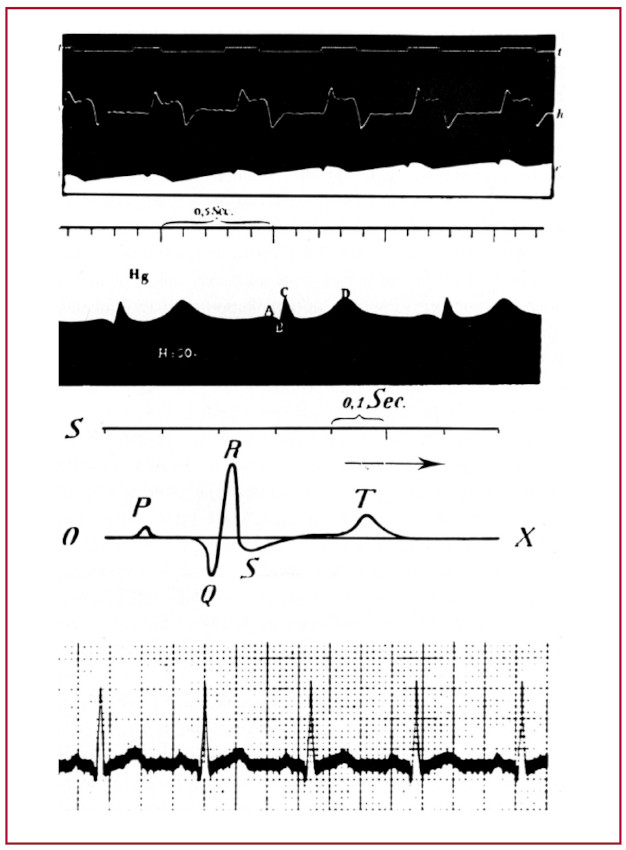
With his new device he recorded five deflections which he named P, Q, R, S and T. Einthoven never explained why he chose this sequence of letters; the reason remains unknown and has given rise to various elucubrations*.
This new galvanometer was easier to use, artifact-free, sensitive and accurate. However, it could not be transported to the hospital. It weighed just over 270 kilograms, took up two pieces, needed a huge water jacket for cooling, and required several people to operate it. In addition, large buckets of saline solution were used as electrodes with the subject immersing his hands and feet in them. On the other hand, it was not easy for patients to leave the hospital. Thus, for clinical use, Einthoven had to think of a method to transmit the electrocardiographic recordings from the hospital to his physiology laboratory in Leiden (where the galvanometer was located) over a distance of about one and a half kilometers. He decided to use the subway wires of the city's telephone network; he called these successful recordings "telecardiograms"; the first of which was made on March 22, 1905 on a "healthy and vigorous man". (6) Unfortunately, the use of this system was not free of charge and had to be financed both by Dr. Einthoven's laboratory and by the hospital's Department of Medicine; but on one occasion, the head of the latter suspended payments and its use was terminated.
However, this did not diminish Dr. Einthoven's enthusiasm, and over time he continued to make various improvements to make it more practical; thus, he proposed to reduce the number of electrodes from Waller's five to three, using the latter to construct an imaginary inverted equilateral triangle, centered on the thorax and with the vertices on both arms and one leg (Einthoven's triangle, as it would be known in the future). (7)
However, like many other great ideas, Einthoven initially encountered no small amount of resistance for the scientific community's recognition of this new diagnostic tool. It should be remembered that Waller himself had not shown much enthusiasm for the nascent electrocardiography (vide supra), and that, in fact, he tried to dissuade Einthoven from publishing his ideas. (8)
Despite this Einthoven continued with great conviction to see great diagnostic potential in his instrument ("A new chapter has been opened in the study of heart disease, which helps suffering humanity") and made modifications to the device, finally being recognized in two acclaimed articles, one of them published in 1908 (9)** and the other in the Lancet in 1912. (10)
In the following decade the clinical application of electrocardiography began to expand, and clinical articles began to appear from all over the world. After 1913, Einthoven made no major contribution to electrocardiography but taught and lectured extensively on the subject. Surprisingly he never published a book based on his work.
This new diagnostic tool was soon manufactured by the Cambridge Scientific Instrument Company, founded by Horace Darwin (1851-1928), the youngest son of Charles Darwin (1809-1882), who was the first to officially market electrocardiographs. One of the first three was given to the British Cardiologist Sir Thomas Lewis (1881-1945) (Figure 2B), who for more than a decade, between 1908 and 1920, corresponded with Einthoven and made important contributions to the understanding of the mechanisms of arrhythmias, being the one who undoubtedly brought the new device to the patient's bedside and definitively endorsed its real usefulness, for which he is considered by many the "father of clinical cardiac electrophysiology". Einthoven formally acknowledged the contributions of Dr. Lewis during the Nobel Prize lecture. (11)
In 1924, Einthoven was awarded the Nobel Prize in Physiology or Medicine "for his discovery of the mechanism of the electrocardiogram". After receiving the 40000 dollar prize money, Einthoven sought out one of his first assistants, Van de Woerd, (who had built many of the parts of the new galvanometer) to share the money. When he learned that the latter had already passed away, he persevered with his idea and managed to find two sisters who had survived him and lived in poverty, and gave them half of the sum. During his last years he devoted himself to teaching and lecturing on electrocardiography. He died on September 29, 1927 at the age of 67 from abdominal cancer.
Recently, advances in artificial intelligence (AI) have been employed in the field of electrocardiography, and ECG interpretation algorithms with the ability to process gigantic amounts of data and identify previously unknown patterns have become available. (12) Recent studies show how the use of ECG-AI models can accurately detect reduced left ventricular ejection fraction in asymptomatic patients. Others have pointed out their potential to detect patients with a high probability of atrial fibrillation, and some algorithms have even managed to diagnose the age and sex of patients independently of the clinical data provided.
The true potential of ECG-AI models is beginning to materialize, allowing the ECG to remain a powerful tool in cardiology for years to come, continuing the path initiated by Einthoven.
Einthoven built his work on that of preceding or contemporary physiologists and each of these insights was an important contribution to his ultimate goal. The interval between the initial development of the invention, its clinical establishment and final recognition can be measured in decades. He always proclaimed that science should be placed at the service of mankind. He did not get to see how, a few years after his death, his device became an instrument of universal use.
Notes
* Einthoven chose for his nomenclature not to use the first letters of the alphabet, but other “intermediate” letters, so that if new waves were identified, an alphabetical order could be followed. This was the case of the U wave described later.
** “Additional considerations on the electrocardiogram”. It was in this document, which contained more than 5000 records, that the abbreviation for electrocardiogram was established as EKG (from the German, Elektrokardiogramm). After World War II it was changed to ECG (from the English, electrocardiogram).
REFERENCES
2. Cajavilca C, Varon J. Resuscitation great. Willem Einthoven: the development of the human electrocardiogram. Resuscitation. 2008;76:325-8. https://doi.org/10.1016/j.resuscitation.2007.10.014
3. Lama A. Einthoven. El hombre y su invento [Einthoven: the man and his invention]. Rev Med Chil. 2004;132:260-4. https://doi.org/10.4067/S0034-98872004000200018
4. Fisch C. Centennial of the string galvanometer and the electrocardiogram. J Am Coll Cardiol. 2000;36:1737-45. https://doi.org/10.1016/s0735-1097(00)00976-1.
7. Einthoven W. Eur Heart J. 2019;40:3075-8. https://doi.org/10.1093/eurheartj/ehz663.
8. Waller AD. Remarks on the technique of electrocardiography for clinical purposes. Lancet 1913;182:379-82. https://doi.org/10.1016/S0140-6736(01)77789-6
9. Einthoven W. Weiteres über das Elektrokardiogramm. Pflügers Archiv: Eur J Physiol 1908;122:517-84. https://doi.org/10.1007/BF01677829
10. Einthoven W. The Different Forms of the Human Electrocardiogram and Their Signification. Lancet. 1912;179:853-61. https://doi.org/10.1016/s0140-6736(00)50560-1
11. Pahlm O, Uvelius B. The winner takes it all: Willem Einthoven, Thomas Lewis, and the Nobel prize 1924 for the discovery of the electrocardiogram. J Electrocardiol. 2019;57:122-7. https://doi.org/10.1016/j.jelectrocard.2019.09.012
12. Kashou AH, May AM, Noseworthy PA. Artificial Intelligence-Enabled ECG: a Modern Lens on an Old Technology. Curr Cardiol Rep. 2020;22:57. https://doi.org/10.1007/s11886-020-01317-x