

Infective endocarditis (IE) is a systemic disease resulting from an infection, usually bacterial, of the endocardial surface of the heart. Although it may occur in apparently healthy valves, most cases occur in patients with preexisting valvular disease, in those with prosthetic heart valves, or in patients with certain heart conditions, in whom trauma resulting from turbulent or highpressure blood flow (associated with valvular or cardiac structural defects) together with inflammatory or hypercoagulable states, leads to the formation of fibrinplatelet thrombi, to which microorganisms may attach during episodes of bacteremia.
The microorganisms most frequently associated with IE vary depending on whether the valves are native or prosthetic and whether the patient is an intravenous drug user. In endocarditis involving native valves, Viridans group streptococci are the most common, followed by Staphylococcus aureus and coagulasenegative staphylococci, especially S. epidermidis and S. lugdunensis, while Enterococcus spp., HACEK group bacteria, and fungi, among others, are found in smaller proportions. (1)
Hypertrophic cardiomyopathy (HCM) is a structural heart disease that can cause predisposing hemodynamic abnormalities. However, it is not included among the formal indications for antibiotic prophylaxis in dental procedures according to current guidelines. Evidence regarding its true risk of IE is limited and, in some studies, contradictory. In this context, the occurrence of endocarditis caused by unusual pathogens in patients with HCM offers an opportunity to further explore the association between HCM and IE.
We present a 66-yearold female patient with multiple cardiovascular risk factors, a history of myocardial infarction treated with percutaneous coronary intervention, and HCM diagnosed in 2022. She had systolic anterior motion of the anterior mitral leaflet and severe mitral regurgitation, for which alcohol septal ablation was performed with a limited clinical response. Other relevant medical history includes multiple urinary tract infections and dental infections.
The patient presented to the Emergency Department with intermittent precordial pain of varying intensity, peaking at 10/10, oppressive in nature, without radiation and lasting for several minutes, in a setting of fever of up to 38.5°C.
On physical examination, blood pressure was 96/69 mmHg, heart rate 90 bpm, body temperature 37.8°C, and respiratory rate 20 breaths/min. Heart sounds were normal, with a 3/6-intensity holosystolic murmur that was audible over four areas of the precordium. No other significant findings. The admission ECG showed sinus rhythm, 90 bpm, axis +60°, asymmetric T waves, and a flat ST segment.
Admission to the Coronary Care Unit was decided. Transthoracic echocardiography revealed severe septal hypertrophy, with myocardial texture abnormalities consistent with hypertrophic cardiomyopathy, inferobasal and medial hypokinesis, marked mitral annular calcification with significant left atrial dilation, and a very high dynamic gradient across the left ventricular outflow tract.
Troponin levels were positive in two measurements, so coronary cineangiography was performed, which showed patent stents with no new angiographically significant lesions.
Given the context of persistent fever, a transesophageal echocardiogram was indicated. It revealed a 2.5 x 2.8 cm mass at the free edge of the anterior mitral valve which protruded into the left ventricle during diastole and caused severe mitral regurgitation. Blood cultures were obtained and were positive for Staphylococcus saprophyticus. Based on these findings, the patient was diagnosed with IE according to the modified Duke criteria, and cefazolin therapy was initiated.
The patient developed refractory acute pulmonary edema attributed to the progression of mitral regurgitation, so valve replacement surgery was indicated.
During the surgical procedure, the mitral valve was found to have multiple vegetations, exuberant tissue proliferation, and leaflet damage. The valve annulus was difficult to identify because it was invaded by an abscess in the anterior region; therefore, the mitral valve was replaced with a size 25 mechanical prosthesis (Figures 1 and 2).
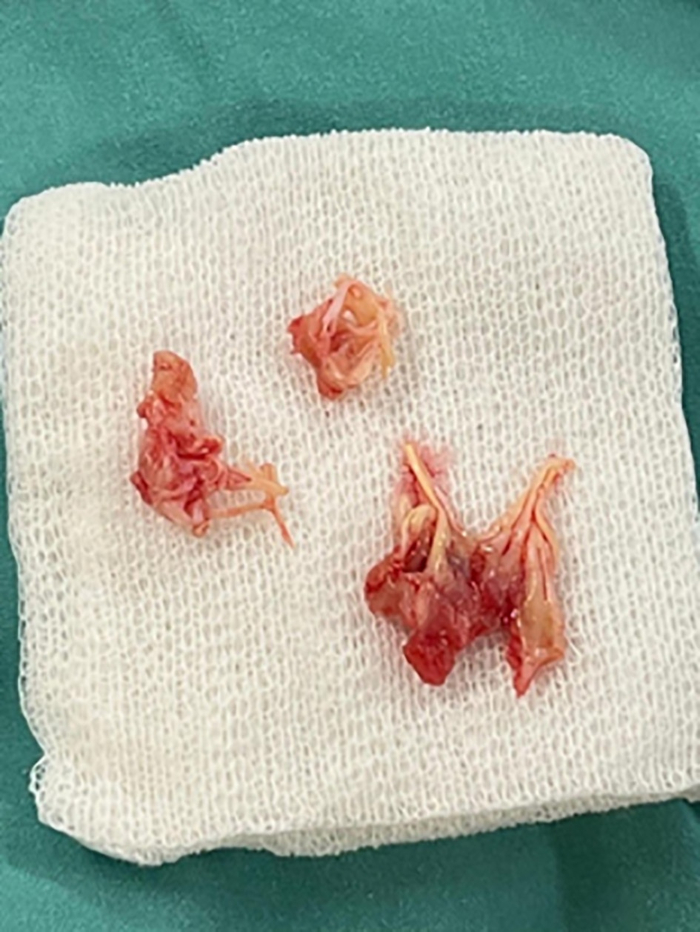
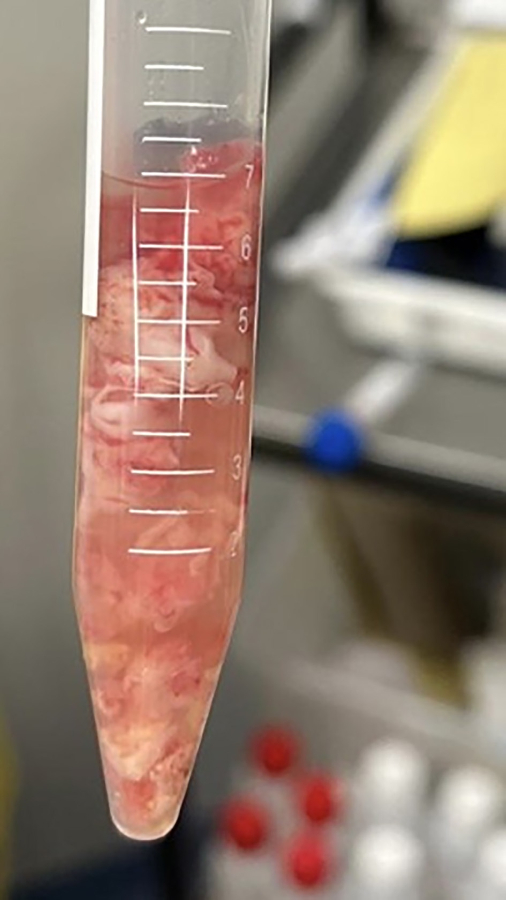
During the first 48 hours after surgery, the patient presented alternating atrial fibrillation and complete atrioventricular block that did not resolve one week after surgery; therefore, a permanent DDDR pacemaker was implanted. She showed no other significant complications, so she was discharged after completing the 6-week antibiotic therapy with cefazolin 1 g IV every 8 hours, following the last negative blood culture.
During subsequent outpatient followup visits, the patient has shown a favorable clinical course.
S. saprophyticus is a common bacterium of the genitourinary tract. Rectal, vaginal, and urethral colonization is associated with urinary tract infection (UTI) caused by this organism, making it the second most common pathogen in uncomplicated UTI in women. This microorganism belongs to the group of coagulasenegative staphylococci, responsible for 5-8% of cases of bacterial endocarditis involving native valves. However, 85% of these cases are caused by S. epidermidis. The clinical course of this condition typically involves high rates of valve destruction, heart failure, and death, and more than half of cases require valve replacement. IE caused by S. saprophyticus has been rarely reported. A study conducted in 2020 reported that, as of that date, only four cases had been published. (2,3)
There are few reported cases of IE in patients with HCM in the literature. Streptococcus is the predominant pathogen. The mitral valve is the most commonly affected, and the majority of cases occur in patients with outflow tract obstruction, suggesting that the length of the mitral leaflets and turbulent blood flow in the left ventricular outflow tract are factors that may erode the endocardium, making these patients susceptible to IE. (4) Complications are common, and 43% of patients underwent surgical valve replacement, according to a Spanish registry including 27 hospitals. Mortality is variable but remains extremely high (between 22% and 42%, depending on the series). (5)
Although patients with HCM have an 18- to 28-fold higher risk of IE than the general population, the American Heart Association guidelines have excluded HCM from the list of cardiac conditions requiring antibiotic prophylaxis for procedures since 2007. (6)
Bacterial endocarditis caused by Staphylococcus saprophyticus in a native valve is an extremely rare condition. Although the association between HCM and IE has been documented, the literature is scarce and limited to case reports and small case series due to the low incidence of this condition.
This case contributes additional evidence supporting HCM as a predisposing condition for IE and highlights the need to reassess the role of antibiotic prophylaxis in patients with HCM to minimize the risk of this potentially serious disease.