

INTRODUCTION
Hypertension has a high prevalence among adults aged 60 years or older, reaching 70 to over 80 percent after 70 years of age (1,2), with isolated systolic hypertension (ISH) being the most common form in most cases. (3,4) Isolated systolic hypertension is defined as a systolic blood pressure (SBP) above 140 mmHg with a diastolic blood pressure (DBP) below 90 mmHg. Numerous studies and meta-analyses have demonstrated the clear benefit of treating ISH in elderly patients, including those over 80 years of age. (4-6)
Hypotension caused by antihypertensive drugs, whether symptomatic or not, is one of the most concerning adverse effects in elderly patients with hypertension. It can lead, on the one hand, to the adjustment or discontinuation of medication—with its negative clinical consequences—and, on the other hand, to complications such as falls with a risk of fractures, cognitive impairment, renal dysfunction, and silent cerebral lesions. (7-10)
However, recent studies in the literature have demonstrated the safety and significant reduction in cardiovascular morbidity and mortality in patients whose systolic SBP was lowered to levels close to 120 mmHg or tolerated level through treatment; for example, the recently published Hypertension Guidelines from the European Society of Cardiology suggest a target of 120–129 mmHg for SBP, if well tolerated, for all adult patients up to 85 years of age. (11)
Twenty four-hour ambulatory blood pressure monitoring (ABPM) has demonstrated, among other things, greater accuracy in assessing blood pressure (BP) behavior during daily life and the response to specific treatment. (12,13)
The objective of our study was to assess the presence and frequency of symptomatic and asymptomatic hypotension in elderly patients over 65 years of age who were receiving antihypertensive treatment, using ABPM.
METHODS
We retrospectively analyzed ABPM recordings from 12 177 patients collected between January 2017 and July 2025 at a single center specializing in hypertension in our city. Subjects attended exclusively during the morning hours (between 8:00 a.m. and 10:00 a.m.), when the monitoring device was applied. Among the 12 177 ABPM recordings, 1327 were excluded due to technical deficiencies, leaving a total sample of 10 850 studies. Of these, 1779 (16.4%) were from patients over 65 years of age, of whom 322 were excluded because they were not currently receiving antihypertensive treatment. This left a final sample of 1457 studies for analysis. All patients had ISH and were independent, and several had associated comorbidities.
Of the final sample analyzed, 864 patients (59.3%) were women, with a mean age of 73.1 years (range 65–96). Patients were divided into three age groups: 65 to 69 years (G1, n=539, 37%), 70 to 79 years (G2, n=670, 46%), and 80 years or older (G3, n=248, 17%). (Table 1)
The ABPM studies were performed using calibrated SpaceLabs 90207 and 90217 devices (SpaceLabs Healthcare Company Headquarters: 5150 220th Ave SE, Issaquah, WA 98029, PO Box 7018), in accordance with current technical quality standards and using the normal/abnormal thresholds accepted by the various guidelines of hypertension societies, including national ones. Briefly, the studies had to have at least 70% valid recordings; the absence of only one hourly recording was accepted; and BP values obtained during the afternoon nap were not considered. Hypertension was considered uncontrolled despite treatment when the daytime average was ≥ 135 mmHg for SBP and/or ≥ 85 mmHg for DBP; or when the 24-hour average was ≥ 130 mmHg for SBP and/or ≥ 80 mmHg for DBP. Hypotension is defined as a decrease in systemic blood pressure to below 90 and 60 mmHg for systolic and diastolic blood pressure, respectively, or a mean arterial pressure (MAP) <65. .(14) As the various hypertension guidelines do not clearly define the cutoff levels for classifying hypotension based on ABPM, and given the advanced average age of our patients, we agreed to define hypotension if any of the following four conditions were observed: daytime systolic blood pressure (DSBP) or 24-hour systolic blood pressure (SBP24) <100 mmHg; or daytime mean blood pressure (DMBP) or 24-hour mean blood pressure (MBP24) <73 mmHg, based on a SBP and DBP reading of 99–60 mmHg (DBP + 1/3 of the difference) The daily study reports were analyzed to identify the symptoms reported by the patients.
Table 1
Age distribution of the total sample (n=1457) and of patients with hypotension (n=57)
| Variable | Total | 65 to 69 years | 70 to 79 years | 80 years or older |
|---|---|---|---|---|
| Total | 1457 | 539 (37%) | 670 (46%) | 248 (17%) |
| Women | 864 | 294 (34%) | 400 (46,3%) | 170 (19.7%) |
| Men | 593 | 245 (41.3%) | 270 (45,5%) | 78 (13.2%) |
| Average age (years) | 73.1 | |||
| Hypotension | ||||
| Total | 57 | 31 (54.4%) | 17 (29.8%) | 9 (15.8%) |
| Women | 35 | 23 (65.7%) | 11 (31.4%) | 1 (2.9%) |
| Men | 22 | 8 (36.4%) | 6 (27.3%) | 8 (36.4%) |
| Average age (years) | 69 |
Statistical Analysis
Results were analyzed using descriptive statistics by means of frequencies and percentages for categorical variables and measures of central tendency and dispersion for quantitative variables. Associations between categorical variables were described using contingency tables, and associations between continuous quantitative variables using scatter plots. The chi-square test was used to evaluate associations between categorical variables. A p value <0.05 was considered statistically significant. All analyses were performed using the R software version 2.6.2 (R Core Team, 2008)
Ethical Considerations
The study was approved by our institution’s Ethics Committee and complied with the requirements of the Declaration of Helsinki. (15)
RESULTS
Mean (standard deviation, SD) BP values obtained in the 1457 patients were as follows: DSBP: 130.01 (12.92) mmHg and SBP24: 126.14 (12.03) mmHg; DMBP: 93.86 (8.86) mmHg; and for MBP24: 90.29 (8.45) mmHg, respectively. Mean BP values showed statistically significant differences among the three groups, p < 0.001. (Table 2)
Table 2
Blood pressure recordings obtained in the general population studied (n=1457)
| Variable | Total | 65 to 69 years | 70 to 79 years | 80 years or older | P-value |
|---|---|---|---|---|---|
| DSBP | 130.01 (12.92) | 129.14 (13.67) | 130.55 (11.9) | 130.54 (13.92) | <0.001 |
| SBP24 | 126.14 (12.03) | 125.3 (12.28) | 126.56 (11.41) | 126.94 (13.12) | < 0.001 |
| DMBP | 93.86 (8.86) | 94.32 (9.21) | 93.76 (8.45) | 93.1 (9.16) | < 0.001 |
| MBP24 | 90.29 (8.45) | 90.57 (8.77) | 90.24 (8.06) | 89.8 (8.77) | < 0.001 |
DSBP: Daytime Systolic Blood Pressure; SBP24: 24-hour Systolic Blood Pressure; DMBP: Daytime Mean Blood Pressure; MBP24: 24-hour Mean Blood Pressure. Values are presented as mean (standard deviation)
Among the 1457 studies analyzed, 57 (3.91%) met the criteria for hypotension, and in only 9 of them (16%), patients reported dizziness and weakness as the only symptoms likely attributable to hypotension. None reported more serious effects such as syncope or falls. Mean age for these 57 patients was 68.8 years (Table 1), while BP values showed no significant differences (Table 3)
Table 3
Blood pressure values obtained in the population with hypotension (n=57)
| Variable | Total | 65 to 69 years | 70 to 79 years | 80 years or older | P-value |
|---|---|---|---|---|---|
| DSBP | 94.02 (3.74) | 94.52 (3.69) | 93.88 (4.04) | 92.56 (3.28) | 0.384 |
| SBP24 | 93.95 (3.44) | 94 (3.71) | 93.82 (3.21) | 94 (3.24) | 0.985 |
| DMBP | 71.05 (4.08) | 71.77 (3.96) | 71.12 (4.43) | 68.44 (3) | 0.096 |
| MBP24 | 70.6 (3.62) | 71.03 (3.75) | 70.71 (3.75) | 68.89 (2.62) | 0.297 |
DSBP: Daytime Systolic Blood Pressure; SBP24: 24-hour Systolic Blood Pressure; DMBP: Daytime Mean Blood Pressure; MBP24: 24-hour Mean Blood Pressure. Values are presented as mean (standard deviation)
Of the 57 cases of hypotension, 53.5% (n = 31) corresponded to Group 1, 30.7% (n = 17) to Group 2, and 15.8% (n = 9) to Group 3
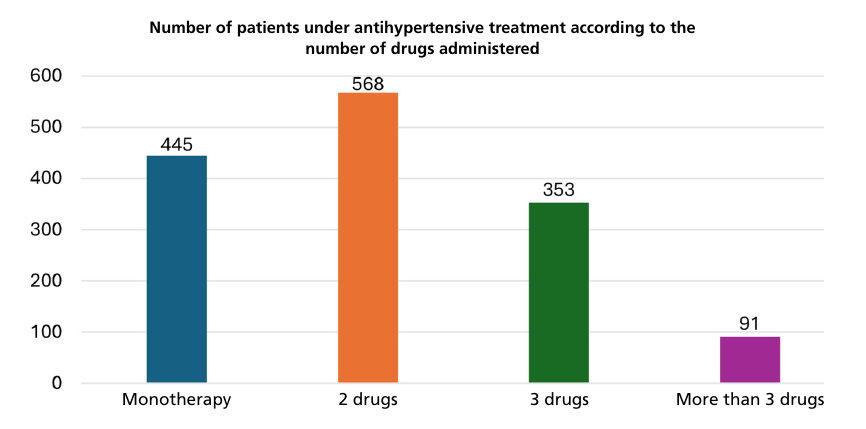
The average number of drugs per patient in the 1457 patients were 2.1. Angiotensin II receptor blockers were the most prescribed drugs (48%), followed by calcium channel blockers, diuretics, beta-blockers, and angiotensin-converting enzyme inhibitors, in that order. Of the 1457 patients, 445 (30.5%) were on monotherapy, while 1012 (69.5%) were on combination therapy; among them, 568 (56.1%) were on two drugs; 353 (34.9%) on three drugs; and 91 (8.9%) on three or more drugs. (Figure 1).
Among the 57 patients who suffered hypotension, 25 (43.9%) were on monotherapy, and 32 (56.1%) on combination therapy. In Group 1, 50% were on monotherapy and 50% on combination therapy; in Group 2, 33% were on monotherapy and 66% on combination therapy; and in Group 3, 50% were on monotherapy and 50% on combination therapy.
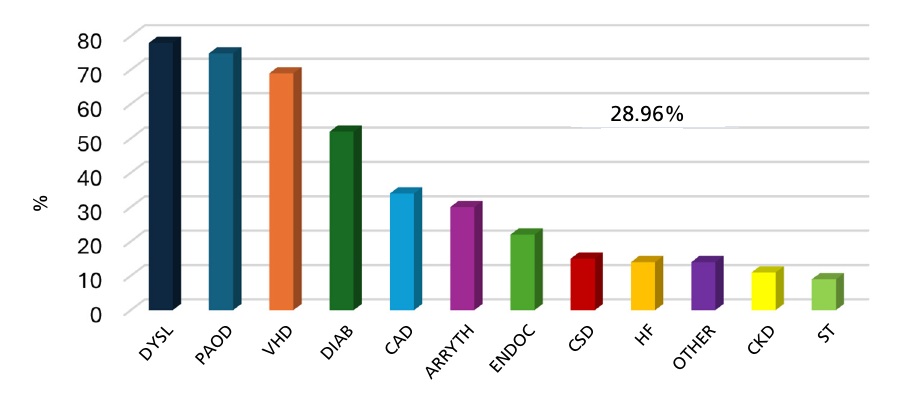
In 28.97% of cases, the study patients had associated conditions, particularly cardiometabolic disorders. (Figure 2) Patients with heart failure were all hemodynamically stable (FC I–II), and patients with kidney disease had 1 to 3 stage renal failure.
DISCUSSION
Hypertension (HTN) and specially ISH is most prevalent in individuals over 60 years of age. (1,2) The demonstrated benefit in terms of reducing fatal and nonfatal cardiovascular events with the treatment of hypertension in these elderly patients, including those over 80 years of age, is clear. (4,7,16) It is accepted that SBP and other factors, such as pulse pressure, are predictors of cardiovascular events in older adults due to decreased arterial compliance. Current recommendations from various hypertension guidelines, meta-analyses, and randomized prospective studies suggest a target reduction of SBP in these patients to as low as possible or tolerated values, or at least <140 mmHg. (17, 18)
One of the most common clinically undesirable effects of antihypertensive treatment—given the need to lower SBP, especially to the newly suggested levels—is the potential to induce symptomatic or asymptomatic hypotension and cause a reduction in cerebral perfusion, which can lead to dizziness, orthostatic intolerance, syncope, or falls resulting in injuries of varying severity. (19) Reduced baroreflex sensitivity to hypotensive stimuli, accompanied by a minimal increase in heart rate, lower total body water and chronic conditions, such as Parkinson’s disease, diabetes, etc., are some of the altered physiological mechanisms and pathologies that may contribute to the onset of hypotension in these elderly patients undergoing antihypertensive treatment. (20,21)
However, hypotension caused exclusively by antihypertensive treatment appears to be less common than expected. The ONTARGET study, conducted in 8502 patients to compare the efficacy of telmisartan versus ramipril in patients with vascular disease and a high risk of diabetes, showed that only 4.8% experienced symptoms of hypotension and only 0.3% had a syncopal episode.(10) The SPRINT study enrolled 9361 non-diabetic patients at high cardiovascular risk, with the aim of evaluating whether a SBP below 120 mm Hg, compared with under 140 mm Hg, resulted in fewer major fatal and non-fatal cardiovascular events and all-cause mortality. In that study, 2.4% of patients in the intensive treatment group developed hypotension, compared with 1.4% in the less intensive group; the incidence of syncope was 2.3% in the intensive group versus 1.7% in the less intensive group; and the incidence of falls requiring hospitalization was 2.2% in the intensive group and 2.3% in the less intensive group. Paradoxically, orthostatic hypotension was lower in the more intensive treatment group (16.6% vs. 18.3% in the other arm). (17)
The most recent Chinese STEP study enrolled 8511 patients with ISH aged 60 to 80 years—24% of whom were aged 70 to 80 years—, with the aim of evaluating whether intensive treatment (SBP 130 to <110 mm Hg) reduced cardiovascular risk compared with standard treatment (SBP 150 to <130 mm Hg). The incidence of dizziness, syncope, and fractures did not differ significantly between the two groups, although the incidence of hypotension was significantly higher in the intensive treatment group (3.4% vs. 2.6%). (18)
Consistent with the above and despite the fact that other studies have found a prevalence of 20% postural and/or postprandial hypotension in older adults with ISH (22) and others as high as 34%—albeit using daytime cutoff values for hypotension based on ABPM starting at 105 mmHg— (23), in our study, we found that only 57 patients (3.91%) had values within the hypotension range. Of these, only 9 (16%) reported symptoms such as dizziness, weakness (especially in the morning), and fatigue. Aside from those mentioned, none reported other symptoms, nor did any experience fall. Unlike other studies, the low percentage of patients with confirmed hypotension in our study has the added value of having been demonstrated using ABPM. Recognizing that the values obtained by this method correspond more accurately to actual BP values compared with those recorded in the clinic, they may more precisely represent the true prevalence of hypotension in this group of patients.
Another aspect to consider is that many older adults with hypertension have varying degrees of frailty, a condition that makes them more prone to hypotension, falls, and hip fractures. (8,22) In the SPRINT study, (17) which included 815 frail patients, the benefit of more intensive BP control was demonstrated in both older adults and frail adults, with adverse events being similar in the two treatment groups and not dependent on frailty. In our subgroup of patients, although frailty may have been present in any of them, among those over 80 years of age—and despite the fact that 50% were taking combination therapies—only 15.8% (9 patients) experienced hypotension, a finding similar to that reported in the aforementioned SPRINT study, where subjects receiving intensive treatment had lower rates of hypotension than those receiving less intensive treatment. Although our study was not designed to assess frailty, the low incidence of hypotension and symptoms once again reinforce the safety—at least from a clinical perspective—of antihypertensive treatment in this age group, which does not appear to depend on the intensity of the treatment.
Another point of interest is the very good control of SBP observed in the analysis of the studies, since the vast majority of patients had their SBP controlled by treatment to the levels recommended by the guidelines in all three groups, and only a small percentage of them had symptomatic hypotension, which once again confirms the safety of increasing the dosage of antihypertensive medications in these patients until BP reduction targets are achieved. This good BP control may corroborate what has previously been demonstrated by others, namely that elderly hypertensive patients with well-controlled BP on treatment experienced orthostatic hypotension less frequently than those whose BP was uncontrolled, supporting the notion that setting a lower BP reduction target does not appear to cause hypotension. (20,21)
Like younger hypertensive patients, most elderly patients will require two or more medications to control their BP, as demonstrated by large studies such as SHEP and Syst-Eur. (5,24) However, in elderly patients outside of urgent or emergency settings, it seems prudent to reduce SBP values gradually until the target is reached to minimize the risk of ischemic symptoms and, especially, hypotension. (25)
Our patient group was no exception regarding the number of drugs used. Analysis of ABPM data from the 1457 patients revealed that 2.1 drugs per patient were required to control BP, with drug combinations being the most used approach. Although angiotensin receptor blockers were the most frequently used drugs, all major classes of antihypertensive agents were employed without significant differences in the incidence of hypotension, which is consistent with the 2017 American College of Cardiology/American Heart Association guidelines, which state that first-line drug classes have a low risk of causing hypotension. (12)
Among the 57 patients in whose ABPM study we confirmed hypotension, single-drug therapy was used in 43.9% (n=25) and combination therapy in 56.1% (n=32). Interestingly, when analyzing the three groups, and despite the fact that in the oldest group (G3) 50% of patients were treated with combination therapies, it was this group that recorded proportionally fewer episodes of hypotension, which confirms the current trend of using combination therapies to control SBP in the very elderly, with few side effects. Various guidelines and meta-analyses suggest that the most important factor in reducing cardiovascular risk is lowering BP in both young and elderly patients, rather than the choice of antihypertensive medication. (26) Our findings are consistent with the above and with those observed in other studies, in which the effective use of the main drug classes was well tolerated by elderly patients and associated with few side effects. (27)
In addition to frailty, elderly hypertensive patients generally have various associated comorbidities, whether cardiovascular or not, which demand the administration of different medications that may affect BP by either raising or lowering it. In our study, 28.9% of patients suffered, in addition to hypertension, from various cardiovascular, metabolic, and non-cardiovascular conditions, most under specific treatment. However, despite this, the medications administered together with antihypertensive drugs did not appear to significantly potentiate the risk of hypotension. These findings were previously observed in other studies where no significant association was found between hypotension and other comorbidities; (28) however, other studies reported an association with diabetes mellitus, dementia, and Parkinson’s disease. (29)
It has been observed that an excessive decrease in DBP may be associated with an increased risk of cardiovascular events, particularly coronary events. There remains controversy regarding the minimum DBP level that should be targeted, particularly in elderly patients with ISH. Studies such as SHEP and INVEST found a significant increase in cardiovascular events when DBP was ≤60 mmHg, (30,31) as this may compromise tissue and coronary perfusion and possibly increase cardiovascular risk. However, other studies have not found this association and attribute the presence of a J-curve not to adverse effect of treatment, but rather to poor physical condition, comorbidities, and/or other medications. (32) Nevertheless, there is consensus against lowering DBP below 55–60 mmHg. In our analysis, no group average DBP fell below this figure.
Study Limitations
Although all patients were advised before and after the study of the need to record—and effectively recorded in the daily report—any symptoms they were experiencing or had experienced, we have no way of verifying actual compliance with this requirement.
Furthermore, despite having investigated the presence of other comorbidities and the use of other medications—some of which likely affect the arterial vasculature—we cannot rule out the presence of other conditions or the use of other medications not reported in the diary, a common occurrence in elderly patients, which could have influenced the SBP values.
Neither a frailty questionnaire was administered, which could have provided additional information of interest to the study.
Conclusions
Our study demonstrated that in elderly patients with ISH undergoing treatment, there was a low incidence of symptoms—and particularly of hypotension—when using the main classes of antihypertensive drugs.
Based on these results and in accordance with the recommendations of most current guidelines, the decision to initiate antihypertensive treatment and the treatment goals should depend less on age and more on frailty and/or associated comorbidities.