

INTRODUCTION
Transcatheter aortic valve replacement (TAVR) is the treatment of choice in patients >75 years with aortic stenosis, those at high surgical risk, and those who are not candidates for surgery. In recent years, its indication has been progressively extended to include intermediate or low risk patients, resulting in an exponential growth in the number of TAVR procedures worldwide. (1-3)
Infective endocarditis (IE) is a rare but clinically significant complication after TAVR, characterized by a distinctive clinical and microbiological profile and a generally unfavorable outcome. (4) Despite its low prevalence, the number of patients at risk of developing this complication is expected to increase considerably in the coming years, as the number of procedures continues to rise and is extending to younger patients with longer life expectancy. (4,5)
Therefore, as IE after TAVR could represent an increasingly common and relevant clinical challenge, it is essential to have a thorough understanding of this condition and its potential complications in order to improve the clinical outcomes for this population. To date, there is little regional information available on its prevalence, characteristics, and clinical course during follow-up.
METHODS
We conducted a single-center, observational and retrospective cohort study. The cohort was made up of adult patients (>18 years) with a prosthetic aortic valve implanted via TAVR due to severe symptomatic aortic valve stenosis between March 2015 and May 2025.
The aim of the study was to describe the prevalence, characteristics, and in-hospital clinical course of IE in patients undergoing TAVR.
Clinical, microbiological, and imaging characteristics at the time of diagnosis were analyzed, as well as the treatments received and in-hospital clinical course. The diagnosis of IE was defined according to the modified Duke criteria, (6) and the disease was classified as "early" (within the first year following the TAVR procedure) or late (after the first year following the TAVR procedure). In addition, the surgical indications for IE were evaluated according to the criteria of the current clinical practice guidelines of the European Society of Cardiology. (6) Finally, in-hospital mortality for the entire cohort was recorded. Data were retrieved from the institutional electronic medical records.
Categorical variables were expressed as absolute and relative frequencies. Continuous variables were expressed as median with the corresponding interquartile ranges (IQR). All the statistical calculations were performed using SPSS 24.0 statistical package (SPSS; Chicago, IL, USA).
RESULTS
A total of 521 patients undergoing TAVR were included. Median age was 84 years (IQR 79-87) and 65% were female. Sixty-seven percent had hypertension, 16% had diabetes mellitus, and 14% had dyslipidemia. Most patients received a self-expanding aortic valve prosthesis (77%), primarily accessed via the femoral artery (72%), often via a surgical approach (69%). Median follow-up to evaluate the prevalence of IE was 620 days (IQR 142-1288).
In our cohort, the incidence of IE was 2.3% (n = 12). According to the modified Duke criteria, nine patients (75%) in this subgroup were classified as definite IE, and three (25%) were classified as probable IE. The median age of the subgroup with IE was 83 years (IQR 78-86) and 75% (n = 9) were men. All these patients had hypertension, while two-thirds of them had dyslipidemia and only one patient had diabetes. (Table 1).
The femoral access was used in 92% of cases with a surgical approach in 83%; and, unlike the global cohort, balloon-expandable prostheses were more commonly used (67%) (Table 1).
Of the total number of patients diagnosed with IE, five (42%) developed early EI and seven (58%) developed late EI (Table 1). Median time from TAVR to the diagnosis of early IE was 87 days (IQR 66-114) and 1142 days (IQR 722-1450) for late IE. Blood cultures were positive in 11 (92%) patients, with Enterococcus faecalis being the most common microorganism in both early (n = 2) and late (n = 3) IE cases. The remaining microorganisms were Staphylococcus epidermidis (n = 3), and Streptococcus hemolyticus, sanguinis, and viridans, with one case each.
Fever was the most common clinical presentation (67%). Vegetations were present on transesophageal echocardiography in 75% (n = 9) of the cases, 33% (n = 4) presented systemic embolism, and prosthetic valve dysfunction occurred in only one patient.
Four patients had indication for surgery: two due to cardiogenic shock refractory to standard measures, one due to a large vegetation (>10 mm), and one due to persistent positive blood cultures despite antibiotic treatment guided by an antibiogram. However, only one patient ultimately underwent surgery, with favorable outcome. In-hospital mortality was 16% (n = 2); although these two patients had indication for surgery, the intervention was not carried out due to frailty. All survivors received antibiotic treatment guided by an antibiogram for six weeks, and 33% (n = 4) subsequently received suppressive antibiotic treatment.
Table 1
Clinical and echocardiographic characteristics, clinical presentation, and outcome of patients with IE after TAVR
| Variables | n = 12 |
|---|---|
| Clinical characteristics | |
| Age, years | 83 (78-86) |
| Male sex | 9 (75%) |
| Body mass index | 30 (25-33) |
| Diabetes mellitus | 1 (8%) |
| Chronic kidney disease | 5 (42%) |
| Previous coronary artery bypass graft surgery | 2 (17%) |
| Echocardiographic characteristics | |
| Vegetation > 10 mm | 3 (25%) |
| Prosthetic valve dysfunction | 1 (8%) |
| Annular involvement | 1 (8%) |
| LVEF > 55% | 11 (92%) |
| Clinical presentation and laboratory test results on admission | |
| Positive blood cultures | 11 (92%) |
| White blood count/mm3 on admission | 8990 (6827-12 900) |
| Platelet count/mm3 on admission | 153 850 (87 125-203 600) |
| C-reactive protein | 64 (30-84) |
| In-hospital outcome | |
| Embolism | 4 (33%) |
| Shock parameters | 2 (17%) |
| Requirement of MV | 2 (17%) |
| Redo surgery | 1 (8%) |
| In-hospital mortality | 2 (16%) |
IQR: interquartile range; LVEF: left ventricular ejection fraction; MV: mechanical ventilation
Qualitative variables are presented as n (%) and quantitative variables as median (interquartile range)
DISCUSSION
The main findings of this single-center study were: 1) the incidence of IE after TAVR in our cohort was 2.3%; 2) the microorganism most commonly isolated was Enterococcus faecalis; 3) antibiotic treatment guided by an antibiogram was the primary therapeutic strategy, with only one surgical intervention out of four patients with indication for surgery; and 4) in-hospital mortality was 16% (Figure 1).
Figure 1
Graphical summary of the main findings of our single-center study
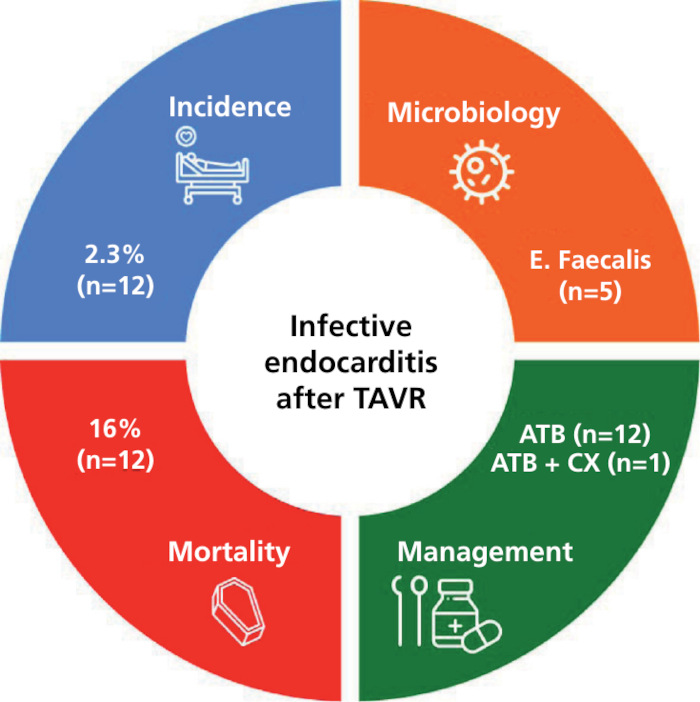
ATB: antibiotics, CX: surgery, TAVR: transcatheter aortic valve replacement
First, the prevalence of IE in our cohort is similar to that reported in prior international studies, with an estimated annual incidence from 0.2 to 2%. (4,7) However, there is considerable variability in the prevalence and incidence of IE after TAVR, as most data come from observational registries with highly heterogeneous populations. (4,8) Furthermore, few studies have compared the incidence of IE after TAVR versus IE after surgical aortic valve replacement (SAVR). So far, their incidence appears to be similar, as only two studies have shown a lower incidence associated with TAVR. (9,10)
Another issue to highlight is the onset of IE during follow-up. In our cohort, five patients-42% of cases-experienced the event during the first year after the procedure (early IE). Few studies have compared the incidence of early IE after TAVR with that after SAVR, and although the less invasive nature of TAVR could be associated with a lower incidence of early IE, the incidence is also similar with both techniques. (11-13) However, in recent years, there has been a global trend towards a minimalist TAVR approach. It seems reasonable to believe that this technique would reduce the incidence of IE after TAVR. However, to date only one study has analyzed this hypothesis, and although it showed a trend toward a lower incidence of IE, no statistically significant differences were found, with only a trend toward a lower proportion of early IE. (14,15)
Regarding the microorganisms most commonly responsible for IE after TAVR, enterococci are the predominant agents in most series, including our cohort. (14,16,17) These microorganisms have a strong affinity for warm, moist habitats such as the groin region. (18) In this regard, the utilization of the transfemoral access as the preferred method for TAVR on a global scale may be associated with the isolation of this microorganism. In our series, 92% of cases that developed IE were treated using the transfemoral access.
The management of patients who develop IE following TAVR is challenging. To date, there are no randomized studies comparing different antibiotic regimens or therapeutic strategies in patients with IE after TAVR. Consequently, its treatment is extrapolated from data on IE in surgical prosthetic valves. (6) Since this is a type of IE involving prosthetic heart valves, treatment should be prolonged and last at least six weeks. (19) In our cohort, all of our patients received antibiotic treatment guided by an antibiogram during that period, and 33% also received subsequent suppressive treatment. Conservative treatment, defined as antibiotic therapy alone, is the most commonly used strategy in all series due to the fact that patients who undergo TAVR are currently considered to be at high surgical risk. This management could change in the coming years due to the increasing utilization of this technique among low- and intermediate-risk patients. In our cohort, only one of the five patients with indication for surgery was ultimately intervened, with favorable postoperative outcome.
There is a paucity of evidence comparing surgical intervention with conservative treatment in patients with indication for surgery. Notably, these studies have not demonstrated a clear benefit of surgery versus antibiotic treatment guided by an antibiogram. Surgery did not reduce in-hospital mortality, hospital readmissions, or one-year mortality. (20-22) We believe that this can be explained, once again, by the high surgical risk, which is at times prohibitive, of this group of patients. In the EXPLANT-TAVR registry, (23) patients undergoing transcatheter heart valve explant secondary to IE had higher 30-day and 1-year stroke rates and longer intensive care unit and hospital stays, compared to the subgroup of patients with other mechanisms of bioprosthetic valve dysfunction. Moreover, these patients had a higher 3-year mortality rate, which did not reach statistical significance given the relatively small sample size of this unique cohort and the reduced number of events. Despite the limited evidence, no specific surgical recommendations have been established for this population to date; indications are usually individualized according to each center's experience.
Finally, in our cohort. IE after TAVR was associated with high in-hospital mortality. According to the literature, in-hospital mortality rates have been reported to range from 16% to 64%. Once again, this wide range reflects the heterogeneity of the available data on this topic. However, and despite this variability, these figures are significantly higher than those reported for other types of prosthetic valve IE. (17,23-25)
In conclusion, IE after TAVR is a rare but clinically relevant complication with high in-hospital morbidity and mortality. Despite advances in minimally invasive techniques and antibiotic management guided by an antibiogram, significant diagnostic and therapeutic challenges persist, particularly given the lack of robust evidence and specific guidelines for this population. The high prevalence of Enterococci as etiological agents, particularly after transfemoral procedures, underscores the need for tailored preventive strategies. Given the limited efficacy of surgery in terms of survival and the predominance of conservative treatment, it is essential to individualize the clinical approach and encourage prospective studies to establish clearer, evidence-based recommendations.
Conflicts of interest
None declared.
(See authors' conflict of interests forms on the web).
Source of funding
This work received no public or private financial support.