REVIEW ARTICLE
Accelerated Diagnostic Protocols Based on
High-Sensitivity Troponin in the Diagnosis of Thoracic Pain: A Systematic
Review
Protocolos de
diagnóstico acelerado basados en troponina de alta
sensibilidad en el diagnóstico del dolor torácico: una revisión sistemática
John
J. Sprockel1, 2, Johann M. Álvarez1,
Juan C. Bohórquez1, Geober
E Herrera3, Jesús E Hurtado3,
Juan P. Álzate4, Juan J Diaztagle1, 5
1 Health Sciences University Foundation School of
Medicine, Division of Internal Medicine Hospital de San José de Bogotá. Bogotá, Colombia.
2 Research Institute of the Health Sciences University
Foundation. Bogotá, Colombia.
3 Health Sciences University Foundation School of
Medicine, Emergency Department – Hospital de San José de Bogotá. Bogotá, Colombia.
4 Research Department, Health
Sciences University Foundation. Bogotá, Colombia.
5 Department of Physiology, School of Medicine, Universidad
Nacional de Colombia. Bogotá Seat. Bogotá, Colombia
Address for reprints: John Jaime Sprockel Díaz. Email: jjsprockel@fucsalud.edu.co. Calle 10 No. 18-75
Hospital de San José
Rev Argent Cardiol 2023;91:252-266. http://dx.doi.org/10.7775/rac.v91.i4.20647
ABSTRACT
Background: The progress of high-sensitivity troponin for
accelerated diagnostic protocols to assess chest pain, allows the
identification of patients admitted to the emergency room with low-risk chest
pain for a major adverse cardiovascular event, that could be
early and safely discharged, saving time and resources.
Objective: The aim of this study was to assess clinical trials using accelerated
diagnostic protocols based on high-sensitivity troponin.
Methods: A search of randomized clinical trials evaluating accelerated
diagnostic protocols based on high-sensitivity troponin in emergency services
was carried out in MEDLINE/Ovid, Cochrane and EMBASE database, using the
assessment criteria of the Cochrane manual and the PRISMA strategy.
Results: After screening 3509 studies, 5 clinical trials, including 1513
patients, were analyzed. Early discharges were identified in 409 (27%) of
patients, in 91% of cases for ESC 0/3-h protocols, 72% for 0/1-h, 48% for
EDACS, 40% for HEART, 19% and 32% for ADPT and 8% and 18% for standard care
protocols. The negative predictive value was high, in the 99.1-100% range. Mean
length of hospital stay was lower for the 0/1-h and ESC 0/3-h protocols, with
4.6 and 5.6 hours, respectively.
Conclusions: Accelerated diagnostic protocols in chest pain using
high-sensitivity troponin allow a higher proportion of early discharges with a
low rate of major cardiovascular events, with reduction in length of hospital
stay and resources used.
Key words: Thoracic pain - Accelerated diagnostic protocols - High-sensitivity
troponin - Acute coronary syndrome - Acute myocardial infarction - Coronary
disease
RESUMEN
Introducción:
Los protocolos de diagnóstico acelerado de dolor torácico, con el avance de la troponina de alta sensibilidad, permiten identificar a los
pacientes que ingresan al servicio de urgencias con dolor torácico de bajo
riesgo para un evento cardiovascular adverso mayor, que podrían ser dados de
alta de forma temprana y segura, con ahorro de tiempo y recursos.
Objetivo:
Evaluar ensayos clínicos que utilicen protocolos de diagnóstico acelerado
basados en troponina de alta sensibilidad.
Material
y métodos: se realizó una búsqueda de ensayos
clínicos aleatorizados que evaluaran protocolos de diagnóstico acelerado
basados en troponina de alta sensibilidad en los
servicios de urgencias, en las bases de datos MEDLINE/Ovid,
Cochrane y EMBASE utilizando los criterios de evaluación del manual Cochrane y
la estrategia PRISMA
Resultados:
Tras una tamización de 3509 estudios se incluyeron 5 ensayos clínicos que
incluyeron 1513 pacientes; se identificaron 409 (27%) altas tempranas, el 91%
para el protocolo 0/3 h ESC, 72% para el 0/1 h, 48% para el EDACS, 40% para el
HEART, 19 y 32% para ADAPT y 8 y 18% para el cuidado usual. El valor predictivo
negativo fue alto, en un rango de 99,1 al 100% La duración media de la estancia
hospitalaria fue más baja para los protocolos 0/1 h y 0/3 h ESC, con 4,6 y 5,6
horas respectivamente.
Conclusiones:
Los protocolos de diagnóstico acelerado en dolor torácico que implementan el
uso de troponina de alta sensibilidad permiten lograr
alta proporción de altas tempranas con baja tasa de eventos cardiovasculares
mayores, con disminución del tiempo de estancia y recursos consumidos.
Palabras
clave: Dolor torácico - Protocolos de
diagnóstico acelerado - Troponina de alta
sensibilidad - Síndrome coronario agudo - Infarto agudo del
miocardio - Enfermedad coronaria
Received: 03/19/2023
Accepted: 05/17/2023
INTRODUCTION
People consulting the emergency services for chest
pain require a fast assessment to rule out conditions that may put their life
at risk. (1) The standard procedure when myocardial ischemia is
suspected is to determine its clinical probability according to risk
stratification based on clinical history, physical examination,
electrocardiographic findings and biochemical markers. (2,3) To optimize this process, accelerated diagnostic
protocols (ADP), consisting of the periodic serial assessment of
electrocardiograms and markers of myocardial injury to identify very low risk
of coronary disease patients, have been established to adopt an early discharge
conduct. (4)
The inclusion of high-sensitivity troponins has been
an important landmark in the development of these protocols, as they allow the
fast and safe detection of apparently healthy patients, (5) denoting a high negative predictive value (NPV) for
the diagnosis of acute myocardial infarction, reducing the time of diagnosis
and increasing by 4% the sensitivity compared with conventional troponins. This
has improved the possibility of rapidly and safely defining patients’
condition. (6) Normally, ADP classify patients for study in the
following groups: those of very low probability (rule out), those of low or
intermediate probability (rule-in) who are hospitalized for stratification, and
those of high probability, considered non-ST-segment acute coronary syndromes
(NSTE-ACS), who are managed accordingly. (7,8) Generally, the focus has been placed in achieving a
greater proportion of cases safely classified as rule out, which implies the
successful discharge that is met when the percentage of events in discharged
patients is below 1% in the following 30 days. (9,10)
Three recent guidelines highlight the importance of
using these protocols: the English National Institute for Health and Care
Excellence guideline for the use of high sensitivity tests for the early
discharge of NSTE-ACS, (11) several American Societies of Cardiology, Emergency
and Imaging guidelines for chest pain assessment and diagnosis, (12) and the European guidelines for NSTE-ACS diagnosis
and treatment.
(13) In light of this situation, we carried out a
systematic review of randomized clinical trials evaluating ADP using
high-sensitivity troponins to assess chest pain in patients presenting at the
emergency room with suspected NSTE-ACS.
METHODS
Inclusion and exclusion criteria
Randomized clinical trials (RCT) published in English,
evaluating ADP to manage patients with chest pain and suspected NSTE-ACS in the
emergency services, that used high-sensitivity troponins and reported clinical
events as early discharge (within 4 to 6 hours after admission to the emergency
room), major cardiovascular events (MACE), and length of hospital stay were
included. Studies whose protocols did not have early discharge as endpoint,
those considering the concomitant use of other biomarkers, and those evaluating
troponin only once after admission were excluded. Also, studies published as
poster or abstracts, as well as duplicate reports were excluded from the
analysis. Titles and abstracts of studies identified were independently
screened by two authors (JCB and JEH); the final decision of eligibility was
given by consensus and disagreements were resolved by a third investigator
(JJS).
Study search and selection
A search of the literature was carried out in three
databases: MEDLINE, Cochrane and EMBASE. The terms used for the search were
those grouping the following key words: chest pain, acute coronary syndrome,
accelerated diagnostic protocols, 0/1-, 0/2and 0/3-hour protocols,
high-sensitivity troponin, emergency department, risk stratification, rule-out
strategies and fast confirmation. Figure 1 shows the search strategy. The search was updated on
February 20, 2023.
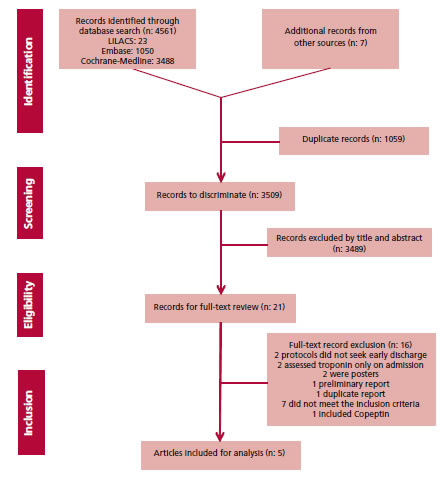
Fig. 1.
PRISMA flow diagram of articles included in the study
Data collection
Information was independently collected by two
reviewers (GEH and JAG) using a format in which the information collected from
the studies was recorded: authors, publication year, center or centers where
the studies were performed, study design and methodology, number of randomized
patients in each group, as well as effectiveness taking into account 30-day,
6-month or one-year MACE, early discharges, length of hospital stay and data
for building a 2 × 2 table to calculate the operative characteristics for the
detection of infarction or death at 30 days.
Risk of bias assessment
Two reviewers (GEH and JAG) independently performed
risk of bias assessment of the studies using the checklist of the Cochrane
collaboration. (14) The points assessed included random sequence
generation, concealment, blinding, incomplete output data, selective output
report and other biases. They were classified by judgement
as low, intermediate or high risk of bias creating graphical descriptions and
summaries. The decision was taken by consensus and disagreements were resolved
by a third investigator (JPA).
Statistical analysis
Considering the study methodological heterogeneity
assessed using the I2 test and the concept resulting from the individual
evaluation of studies under a clinical orientation, it was seen that they were
not comparable, and therefore, we decided against a statistical combination of
results (meta-analysis).
The number of events and the total population of each
study were recorded in 2 × 2 tables to calculate the operative characteristics
for the presence of 30-day MACE outcomes for the different protocols in the
cases in which this information was available in the articles.
The present systematic review is registered as
PROSPERO CRD42021255495.
RESULTS
Initial screening identified 3509 studies, among which
5 met the inclusion criteria. Figure 1 shows the selection process and Table 1 summarizes the methodological characteristic of the
studies included. (15-19). These studies used three types of high-sensitivity
troponin: two Abbot TnI, (16,17) one Siemens TnI (18) and two Roche TnT (15,19). Three studies compared
Table
1. Summary of methodological characteristics of studies
included in the systematic review
|
Study |
Protocol |
Type of study |
Number of patients |
Type of troponin |
Primary outcome |
Other outcomes |
|
Than,
2014 (16) |
ADAPT |
Single center |
544 |
Abbott Architect high-sensitivity troponin I (hs-cTnI) |
Successful early discharge (6 hours) |
MACE on admission and at 30 days |
|
|
Standard care |
|||||
|
Mahler,
2015 (18) |
HEART |
Single center |
282 |
ADVIA Centaur platform TnI-Ultra™
assay (Siemens) |
Rate of objective cardiac tests within
30 days of presentation |
(1) Successful early discharges (2)
length of hospital stay (3) recurrent emergency visits and non-indexed
hospitalization at 30 days. |
|
Standard care |
||||||
|
Than,
2016 (17) |
EDACS |
Pragmatic single center |
560 |
Abbott Architect high-sensitivity troponin I (hs-cTnI) |
Successful early discharge (6 hours |
Proportion of low-risk patients and
6-month MACE |
|
|
ADAPT |
|||||
|
Body,
2017 (15) |
MACS |
Single center |
60 |
hs-cTnT; Roche Diagnostics Elecsys
and heart type fatty acid binding protein |
Successful early discharge (4 hours |
30-day, 3- and 6-month MACE and length
of hospital stay |
|
Standard care |
||||||
|
Chew, 2019 (19) |
0/1 hour protocol |
Non-inferiority
multicenter |
3288 |
hs-cTnT; Roche Diagnostics Elecsys
5th generation |
30-day MACE |
Length of hospital stay; percentage of
early discharges. |
|
ESC 0/3 protocol |
|
ADAPT: Accelerated Diagnostic protocol to Assess Chest
Pain using Troponins EDACS: Emergency Department Acute Coronary Syndrome
HEART: History, ECG, Age, Risk factors, Troponin MACE:
Major Adverse Cardiovascular Events MACS: Manchester Acute Coronary Syndrome
ADP versus standard management (15,16,18) and the other two compared different protocols. (17,19) One work was a pilot study with a small number of
patients; (15) and
only one was a multicenter trial (RAPID-TnT), which
included the highest number of patients and was proposed as a non-inferiority
study.
Main effectiveness outcomes
The five studies described the outcomes of early
discharges, 30-day MACE and length of hospital stay (Table 2). (15,19) In the three trials comparing a protocol versus
standard care, the use of ADAPT, HEART and MACS protocols evidenced higher
percentages of early discharges versus standard care. In the study comparing
two protocols, the EDACS trial showed higher percentages of early discharge
compared with the ADAPT trial (41.6% vs. 30.5%, respectively). (17) In the RAPID TnT
trial, the 0/1-h and ESC 0/3-h protocols reported effective early discharge
rates of 45% and 33%, respectively. (19) Among the studies comparing protocols (ADAPT and
HEART) versus standard care and which reported length of hospital stay in
hours, the protocols significantly reduced these times: 6 vs. 20 hours and 9.9
vs. 21 hours, respectively. The operative characteristics of the intervention
regarding 30-day MACE for each study (Table 3) demonstrate a reduced rate of false negatives, high
sensitivity and high negative predictive values in all the protocols evaluated.
Table
2. Effectiveness results of the different protocols used
in the studies
|
Study |
Protocol |
Early discharge |
30-day mace |
6-month mace |
Average length of
hospital stay |
|
Than, 2014 (16) |
ADAPT |
52 (19.3%) |
1 |
N/R |
6 hours |
|
|
Standard care |
30 (11.0%) |
0 |
N/R |
20 hours |
|
Mahler, 2015 (18) |
HEART |
56 (39.7%) |
0 |
N/R |
9.9 hours |
|
Standard care |
26 (18.4%) |
0 |
N/R |
21.9 hours |
|
|
Than, 2016 (17) |
EDACS |
133 (41.6%) |
0 |
N/R |
6 hours |
|
|
ADAPT |
90 (30.5%) |
0 |
N/R |
6 hours |
|
Body, 2017 (15) |
MACS |
17 (26%) |
3 |
6 |
1 day |
|
Standard care |
5 (8%) |
3 |
5 |
1 day |
|
|
Chew, 2019 (19) |
0/1-hour protocol |
Effective: 748 (45%) Expected: 1187 (72%) |
17 (1%) |
N/R |
4.6 (3.4–6.4) hours |
|
ESC 0/3-hour protocol |
Effective: 545 (33%) Expected: 1493 (91%) |
16 (1%) |
N/R |
5.6 (4.0–7.1) hours |
ADAPT: Accelerated Diagnostic protocol to Assess Chest
Pain using Troponins EDACS: Emergency Department Acute Coronary Syndrome
HEART: History, ECG, Age, Risk factors, Troponin MACE:
Major Adverse Cardiovascular Events MACS: Manchester Acute Coronary Syndrome
N/R: not reported
Table
3. Operative characteristic results for the diagnosis of
the different protocols used in the clinical trials
|
Study |
Protocol |
Sensitivity |
Specificity |
Precision |
PPV |
NPV |
LR+ |
LR- |
|
Than, 2014 (16) |
ADAPT |
97.9 |
22.9 |
35.9 |
21.1 |
98.1 |
1.270 |
0.090 |
|
|
Standard care |
100.0 |
12.6 |
23.9 |
14.4 |
100.0 |
1.145 |
0.000 |
|
Mahler, 2015 (18) |
HEART |
100.0 |
49.3 |
51.8 |
9.3 |
100.0 |
1.971 |
0.000 |
|
Standard care |
100.0 |
23.5 |
28.4 |
8.2 |
100.0 |
1.307 |
0.000 |
|
|
Than, 2016 (17) |
EDACS |
97.3 |
47.5 |
54.1 |
22.1 |
99.1 |
1.854 |
0.057 |
|
|
ADAPT |
100.0 |
34.0 |
40.9 |
14.9 |
100.0 |
1.515 |
0.000 |
|
Body, 2017 (15) |
MACS |
100.0 |
27.0 |
30.3 |
6.1 |
100.0 |
1.370 |
0.000 |
|
Standard care |
100.0 |
8.1 |
12.3 |
5.0 |
100.0 |
1.088 |
0.000 |
|
|
Chew, 2019 (19) |
0/1-hour protocol |
88.1* |
94.7* |
N/A |
38.2* |
99.6& |
16.5* |
N/A |
|
ESC 0/3-protocol |
N/A |
N/A |
N/A |
N/A |
99.4& |
N/A |
N/A |
* for rule in & for rule
out
PPV: Positive predictive value, NPV: negative
predictive value, LR: Likelihood ratio, N/A: not applicable ADAPT: Accelerated
Diagnostic protocol to Assess Chest Pain using Troponins
EDACS: Emergency Department Acute Coronary Syndrome
HEART: History, ECG, Age, Risk factors, Troponin
MACE: Major Adverse Cardiovascular Events MACS:
Manchester Acute Coronary Syndrome
Risk of bias assessment
Most studies presented an intermediate risk
classification, mainly due to the difficulty of blinding the intervention. Only
one study could appropriately blind the intervention (15) (Table 4).
Table
4. Risk
of bias assessment
|
|
Than, 2014 |
Mahler, 2015 |
Than, 2016 |
Body, 2017 |
Chew, 2019 |
|
Random sequences |
● |
● |
● |
● |
● |
|
Allocation concealment |
● |
● |
● |
● |
● |
|
Intervention blinding |
● |
● |
● |
● |
● |
|
Blinding of outcome |
● |
● |
● |
● |
● |
|
Incomplete outcome data |
● |
● |
● |
● |
● |
|
Selective reporting |
● |
● |
● |
● |
● |
|
Other biases |
● |
● |
● |
● |
● |
Black mark: Low risk of bias
Grey mark: Intermediate risk of bias
DISCUSSION
This systematic review identified a small number of
RCT in which the safety of ADP application was demonstrated with a clear
decrease in the length of hospital stay. The results distinctly demonstrate
that the different protocols are more effective in identifying patients who are
candidates for early discharge compared with standard care, as well as for the
reduction of hospital stay. The discussion that we will carry out below will
focus on the analysis of each of the protocols used in the various studies.
0/1 hour protocols: The results seen in the RAPIDTnT study showed that 72% expected early discharges
and 45% effective discharges were achieved with a NPV of 99.6%. This result is
consistent with a systematic review that included 11 014 patients from 10
cohorts, documenting an early discharge rate of 55% with Roche's
high-sensitivity troponin, and greater than 50% for those of Abbott and Siemens
with a NPV of 99. 9% for 30-day MACE. (20) In the TRAPID-AMI study, 63% early discharges were
obtained among 1282 patients, with a NPV of 99.1%, (21) while
in the HIGH-US Study of 2113 patients, 50.4% were discharged with a NPV of
99.7%. (22) Another meta-analysis that included 14 cohorts and 13
899 patients reported an aggregate result of early discharge of 54% and a NPV
of 99.8%. (23) The application of this protocol has certain
practical limitations since it is necessary to have fifth-generation
high-sensitivity troponins that have been validated and whose cut-off values
vary depending on each test. (24) According to the English NICE guidelines, 9
high-sensitivity troponin tests are currently validated for application in
0/1-hour protocols. (11)
ESC 0/3-hour protocol: The same RAPID-TnT
study documented an expected early discharge rate of 92% with a NPV of 99.4%
for the 0/3-hour protocol, the highest documented outcome for any protocol. It
exceeds the aggregate result of early discharge of 66% and NPV of 98.7%
reported by the previously mentioned meta-analysis on 9 works that included 10
237 patients, (23) and the highest report obtained for an individual
cohort, 78.9% (961 of 1,218 patients) with a NPV of 97.9%. (25) However, if the results of effective early discharges
of the RAPID-TnT trial are considered, the
interpretation is different, taking into account the 33% obtained, lower than
for the 0/1-hour protocol. This is also consistent with the results of the
cohort presented by the Badertscher group, which
compared the 0/1and ESC 0/3-hour protocols among 2547 patients, with early
discharges of 60% for 0/1hour and 44% for 0/3-hour protocols. (p<0.001) with a NPV of 99.8% and 99.7%, respectively. (26) A third study on 1920 patients found that early
discharges for the 0/3-hour protocol could reach 65%, although their NPV was
lower than that of the 0/1-hour protocol (98% vs
99%). (27)
Undoubtedly, the issue is under discussion and the
definitions of expected and effective early discharges influence the
interpretation of results.
EDACS protocol: It reported 42% early discharges, with
99.1% NPV, (17) a slightly lower result than that seen in the cohort
study of the same research group, which reported 51% early discharges and 99.6%
NPV (28).
Other validation cohort studies documented possible early discharges of 66.7% (29), 41.6% (30), 35.2% (31), and 58.1% (32), all with NPV higher than 99%. These findings confirm
good performance for this protocol along with a high degree of safety.
HEART protocol: the RCT in which it was evaluated
obtained 39.7% early discharges with a NPV of 100%; (18) it also had a one-year follow-up in which MACE was
documented in 9.9% in the HEART arm vs. 11.3% in the standard care group
(p=0.85). (33) A validation cohort found early discharge rates of
38.4% with a NPV of 99.6 %. (32) Another publication questions the safety of this
protocol by documenting a NPV of 98.1% with a possible early discharge rate of
33.2% (264/794). (34)
ADAPT protocol: it was evaluated in two clinical
trials with an early discharge rate of 19.3% and 30.5% and a NPV of 98.1% and
100%. One of the validations for this protocol by the Than
group (2012), prior to the use of high-sensitivity troponins, found a possible
early discharge rate of 20% with a NPV of 99.7%.
(35) A subsequent validation, with high-sensitivity
troponin, reached a possible early discharge rate of 19.6%, with a NPV of
99.7%. (36) These results are consistent with what is documented
in this systematic review and questions its clinical usefulness, especially
taking into account that in one of these studies better results were obtained
with the comparator protocol, EDACS.
The decision to exclude two recently published
randomized clinical trials should be especially mentioned. Both trials
evaluated the rule out strategy based on undetectable levels in patients
presenting within the first 6 hours of symptoms. The reason for exclusion was
that it was not considered it could be applied to all emergency patients, and
it is therefore a study of troponin rather than an ADP, although its results
are worth presenting as they are part of the initial strategy of the 0/1-hour
protocols: the first was a study that included eight centers in England and
Wales, which obtained a 4-hour early discharge rate of 141/309 (46%) patients
compared with 114/311 (37%) for standard care. (37) The second was the HiSTORIC
(High-Sensitivity Cardiac Troponin on Presentation to Rule Out Myocardial
Infarction) study, which included 31 492 patients from 7 hospitals, reduced the
length of hospital stay by 3.3 hours and hospital admissions by 59%; non-inferiority
was not demonstrated, but the observed differences in myocardial infarction or
cardiac death at 30 days and 1 year favored the early rule-out pathway over
standard care. (38)
The proliferation of ADP makes us carry out a careful
exercise to select the one that adapts to the daily environment of work in the
emergency room. Although guideline recommendations seem to favor protocols that
focus on fixed high-sensitivity troponin values and their variations at 1, 2,
or 3 hours of admission, and do not include clinical prediction rules, we must
make the caveat that it is necessary to have a troponin that has been evaluated
for the selection of cut-off values and the training of staff so that they
become familiar with its implementation. We should note that the 2020 European
NSTE-ACS guidelines (13) removed the ESC 0/3-h protocol from their
recommendations based on the results of three previously discussed large
cohorts (25-27) under the assumption of lower efficacy and safety.
What is stated in this review shows that the results are still contradictory
and that it is necessary to continue exploring the safety of the ESC 0/3-h
protocol.
The high complexity of the problem in question becomes
a limitation of this work. Although we guided the discussion towards the safe
discharge of patients, the issue of cost-effectiveness, which is tangentially
addressed in the studies presented, is beyond discussion. We must note that the
approach to chest pain does not end at this point and the evaluation of
intermediate probability cases that must be hospitalized implies a series of
additional steps not covered by this study.
CONCLUSIONS
The use of ADP in chest pain provides consistent
evidence on the possibility of achieving early discharge with a very low rate
of major cardiovascular events, as well as a benefit in significantly reducing
the length of hospital stay, which decreases overcrowding emergency services,
and allows more efficient use of health resources. The results seem to favor
the 0/1-h and ESC 0/3 h protocols in accordance with current recommendations.
Conflicts of interest
None declared.
(See authors’ conflict of interests forms on the web).
Financing
The present study did not
receive financial support other than that provided by the researchers who are
part of it, being financed with the personal resources of each author.
 https://creativecommons.org/licenses/by-nc-sa/4.0/
©Revista Argentina de Cardiología
1. Roffi
M, Patrono C, Collet J-P, Mueller C, Valgimigli M, Andreotti F, et al.
2015 ESC Guidelines for the management of acute coronary syndromes in patients
presenting without persistent ST-segment elevation: Task Force for the
Management of Acute Coronary Syndromes in Patients Presenting without
Persistent ST-Segment Elevation of the European Society of Cardiology (ESC). Eur Heart J. 2016;37:267-315. https://doi.org/10.1093/eurheartj/ehv320
2. Cullen LA, Mills NL, Mahler
S, Body R. Early Rule-Out and Rule- In Strategies for Myocardial Infarction. Clin Chem. 2017;63:129-39. https://doi.org/10.1373/clinchem.2016.254730
3.
D’Ascenzo F, Biondi-Zoccai
G, Moretti C, Bollati M, Omede P, Sciuto F, et al. TIMI, GRACE and alternative risk scores in Acute
Coronary Syndromes: a meta-analysis of 40 derivation studies on 216,552
patients and of 42 validation studies on 31,625 patients. Contemp Clin Trials. 2012;33:507-14. https://doi.org/10.1016/j.cct.2012.01.001
4. Amsterdam EA, Kirk JD, Bluemke DA, Diercks D, Farkouh ME, Garvey JL, et al. Testing of Low-Risk Patients
Presenting to the Emergency Department With Chest Pain. Circulation.
2010;122:1756- 76. https://doi.org/10.1161/CIR.0b013e3181ec61df
5. Hollander JE, Than M,
Mueller C. State-of-the-Art Evaluation of Emergency Department Patients
Presenting With Potential Acute Coronary Syndromes. Circulation. 2016;134:547-64. https://doi.org/10.1161/CIRCULATIONAHA.116.021886
6. Thygesen
K, Alpert JS, Jaffe AS, Chaitman BR, Bax J, Morrow D, et al. Consenso ESC 2018
sobre la cuarta definición universal del infarto. Rev
Esp Cardiol. 1 de enero de
2019;72:72.e1-72.e27. https://doi.org/10.1016/j.recesp.2018.11.011
7. Twerenbold
R, Boeddinghaus J, Nestelberger
T, Wildi K, Rubini Gimenez M, Badertscher P, et al. Clinical
Use of High-Sensitivity Cardiac Troponin in Patients With Suspected Myocardial
Infarction. Journal of the American College of Cardiology.
2017;70:996-1012. https://doi.org/10.1016/j.jacc.2017.07.718
8. Lowry MTH, Anand A, Mills NL. Implementing an early rule-out pathway
for acute myocardial infarction in clinical practice. Heart. 2021;107:1912-9. https://doi.org/10.1136/heartjnl-2019-316242
9. Than M, Herbert M, Flaws D,
et al. What is an acceptable risk of major adverse cardiac event in chest pain
patients soon after discharge from the emergency Department?: a clinical
survey. Int J Cardiol. 2013;166:752-4. https://doi.org/10.1016/j.ijcard.2012.09.171
10. Campbell CF, Chang AM, Sease KL, et al. Myocardial infarction risk score and
clear-cut alternative diagnosis for chest pain risk stratification. Am J Emerg Med. 2009;27:37-42. https://doi.org/10.1016/j. ajem.2008.01.028
11. National Institue for Health and Care Excellence. High-sensitivity
troponin tests for the early rule out of NSTEMI | Guidance [DG40] [Internet].
NICE;
2020 [citado 16 de enero de 2022]. Disponible en: https://www.nice.org.uk/guidance/dg40.
12. Gulati
M, Levy PD, Mukherjee D, Amsterdam E, Bhatt DL, Birtcher
KK, et al. 2021 AHA/ACC/ASE/CHEST/SAEM/SCCT/SCMR Guideline for the Evaluation
and Diagnosis of Chest Pain: A Report of the American College of
Cardiology/American Heart Association Joint Committee on Clinical Practice
Guidelines. Circulation. 2021;144:e368-454. https://doi.org/10.1161/CIR.0000000000001029
13. Collet J-P, Thiele H, Barbato E, Barthélémy O, Bauersachs J, Bhatt DL, et al. 2020 ESC Guidelines for the
management of acute coronary syndromes in patients presenting without
persistent ST-segment elevation. Eur Heart J. 2021;42:1289-367. https://doi.org/10.1093/eurheartj/ehaa575
14. Higgins JPT, Thomas J,
Chandler J, Cumpston M, Li T, Page MJ, Welch VA
(editors). Cochrane Handbook for Systematic Reviews of
Interventions. 2nd Edition. Chichester
(UK): John Wiley & Sons, 2019. https://doi.org/10.1002/9781119536604
15. Body R, Boachie C, McConnachie A, Carley S, Van Den Berg P, Lecky FE. Feasibility of the
Manchester Acute Coronary Syndromes (MACS) decision rule to safely reduce
unnecessary hospital admissions: a pilot randomised
controlled trial. Emerg Med J. 2017;34:586- 92. https://doi.org/10.1136/emermed-2016-206148
16. Than M, Aldous S, Lord SJ,
Goodacre S, Frampton CMA, Troughton
R, et al. A 2-hour diagnostic protocol for possible cardiac chest pain in the
emergency department: a randomized clinical trial. JAMA Intern Med. 2014;174:51–8. https://doi.org/10.1001/jamainternmed.2013.11362
17. Than MP, Pickering JW,
Aldous SJ, Cullen L, Frampton CMA, Peacock WF, et al. Effectiveness of EDACS
Versus ADAPT Accelerated Diagnostic Pathways for Chest Pain: A Pragmatic
Randomized Controlled Trial Embedded Within Practice. Ann Emerg
Med. 2016;68:93- 102.e1. https://doi.org/10.1016/j.annemergmed.2016.01.001
18. Mahler SA, Riley RF, Hiestand BC, Russell GB, Hoekstra JW, Lefebvre CW, et al.
The HEART Pathway randomized trial: identifying emergency department patients
with acute chest pain for early discharge. Circ Cardiovasc Qual Outcomes. 2015;8:195-203. https://doi.org/10.1161/CIRCOUTCOMES.114.001384
19. Chew DP, Lambrakis K, Blyth A, Seshadri A,
Edmonds MJR, Briffa T, et al. A Randomized Trial of a
1-Hour Troponin T Protocol in Suspected Acute Coronary Syndromes: The Rapid
Assessment of Possible Acute Coronary Syndrome in the Emergency Department
With High-Sensitivity Troponin T Study (RAPID-TnT). Circulation. 2019;140:1543-56. https://doi.org/10.1161/CIRCULATIONAHA.119.042891
20. Chiang C-H, Chiang C-H,
Lee GH, Gi W-T, Wu Y-K, Huang S-S, et al. Safety and
efficacy of the European Society of Cardiology 0/1-hour algorithm for diagnosis
of myocardial infarction: systematic review and meta-analysis. Heart. 2020;106:985-91. https://doi.org/10.1136/heartjnl-2019-316343
21. Mueller C, Giannitsis E, Christ M, Ordóñez-Llanos
J, deFilippi C, McCord J, et al. Multicenter
Evaluation of a 0-Hour/1-Hour Algorithm in the Diagnosis of Myocardial
Infarction With High-Sensitivity Cardiac Troponin T. Ann Emerg
Med. 2016;68:76-87.e4. https://doi.org/10.1016/j.annemergmed.2015.11.013
22. Nowak RM, Christenson RH,
Jacobsen G, McCord J, Apple FS, Singer AJ, et al. Performance of Novel
High-Sensitivity Cardiac Troponin I Assays for 0/1-Hour and 0/2- to 3-Hour
Evaluations for Acute Myocardial Infarction: Results From the HIGH-US Study.
Ann Emerg Med. 2020;76:1-13.
https://doi.org/10.1016/j.annemergmed.2019.12.008
23. Chiang C-H,
Chiang C-H, Pickering JW, Stoyanov KM, Chew DP,
Neumann JT, et al. Performance of the European Society of Cardiology 0/1-Hour,
0/2-Hour, and 0/3-Hour Algorithms for Rapid Triage of Acute Myocardial
Infarction. Ann Intern Med [Internet]. 2021
[citado 6 de enero de 2022]; https://doi.org/10.7326/M21-1499
24. Shabbir
A, Fan L, Fraser G, Cassar MP, Swinburn
J. One-Hour High Sensitivity Troponin Testing: A Safe and Effective Triage Tool
for the Emergency Department. Crit Pathw Cardiol. 2019;18:16-8. https://doi.org/10.1097/HPC.0000000000000162
25. Chapman AR, Anand A, Boeddinghaus J, Ferry
AV, Sandeman D, Adamson PD, et al. Comparison of the
Efficacy and Safety of Early Rule-Out Pathways for Acute Myocardial Infarction.
Circulation. 2017;135:1586-96.
https://doi.org/10.1161/CIRCULATIONAHA.116.025021
26. Badertscher
P, Boeddinghaus J, Twerenbold
R, Nestelberger T, Wussler
D, Puelacher C, et al. P1735Direct comparison of the
0/1h-and 0/3h-algorithm for early rule-out of acute myocardial infarction. Eur Heart J [Internet]. 2018;39
(suppl_1). https://doi.org/10.1093/eurheartj/ehy565.P1735
27. Chapman AR, Fujisawa T,
Lee KK, Andrews JP, Anand A, Sandeman
D, et al. Novel high-sensitivity cardiac troponin I
assay in patients with suspected acute coronary syndrome. Heart.
2019;105:616- 22. https://doi.org/10.1136/heartjnl-2018-314306
28. Stopyra
JP, Miller CD, Hiestand BC, Lefebvre CW, Nicks BA,
Cline DM, et al. Performance of the EDACS-accelerated Diagnostic Pathway in a
Cohort of US Patients with Acute Chest Pain. Crit Pathw Cardiol. 2015;14:134–8. https://doi.org/10.1097/HPC.0000000000000059
29. Than M, Flaws D, Sanders
S, Doust J, Glasziou P,
Kline J, et al. Development and validation of the Emergency Department
Assessment of Chest pain Score and 2 h accelerated diagnostic protocol. Emerg Med Australas. 2014;26:34–44. https://doi.org/10.1111/1742-6723.12164
30. Flaws D, Than M, Scheuermeyer FX, Christenson J, Boychuk
B, Greenslade JH, et al. External validation of the
emergency department assessment of chest pain score accelerated diagnostic
pathway (EDACS-ADP). Emerg Med J. septiembre
de 2016;33:618-25. https://doi.org/10.1136/emermed-2015-205028
31. Shin YS, Ahn S, Kim Y-J, Ryoo SM, Sohn CH, Kim WY. External validation of the emergency
department assessment of chest pain score accelerated diagnostic pathway
(EDACS-ADP). Am
J Emerg Med. 2020;38:2264-70. https://doi.org/10.1016/j.ajem.2019.09.019
32. Stopyra
J, Snavely AC, Hiestand B,
Wells BJ, Lenoir KM, Herrington D, et al. Comparison of accelerated diagnostic
pathways for acute chest pain risk stratification. Heart 2020;106:977-84.
https://doi.org/10.1136/heartjnl-2019-316426
33.
Stopyra JP, Riley RF, Hiestand BC, Russell GB, Hoekstra
JW, Lefebvre CW, et al. The HEART Pathway Randomized Controlled Trial One-year Outcomes. Acad Emerg Med. 2019;26:41-50.
34. Stopyra
JP, Harper WS, Higgins TJ, Prokesova JV, Winslow JE,
Nelson RD, et al. Prehospital Modified HEART Score
Predictive of 30-Day Adverse Cardiac Events. Prehosp
Disaster Med. 2018;33:58- 62. https://doi.org/10.1017/S1049023X17007154
35. Than M, Cullen L, Aldous
S, Parsonage WA, Reid CM, Greenslade J, et al. 2-Hour
accelerated diagnostic protocol to assess patients with chest pain symptoms
using contemporary troponins as the only biomarker: the ADAPT trial. J Am Coll Cardiol. 2012;59:2091-8. https://doi.org/10.1016/j.jacc.2012.02.035
36. Cullen L, Mueller C,
Parsonage WA, Wildi K, Greenslade
JH, Twerenbold R, et al. Validation of
high-sensitivity troponin I in a 2-hour diagnostic strategy to assess 30-day
outcomes in emergency department patients with possible acute coronary
syndrome. J Am Coll Cardiol.
2013;62:1242–9. https://doi.org/10.1016/j.
jacc.2013.02.078
37. Carlton EW, Ingram J,
Taylor H, Glynn J, Kandiyali R, Campbell
S, et al. Limit of detection of troponin discharge strategy versus usual care: randomised controlled trial. Heart.
2020;106:1586-94. https://doi.org/10.1136/heartjnl-2020-316692
38. Anand
A, Lee KK, Chapman AR, Ferry AV, Adamson PD, Strachan FE, et
al. High-Sensitivity Cardiac Troponin on Presentation to Rule Out Myocardial
Infarction: A Stepped-Wedge Cluster Randomized Controlled Trial. Circulation. 2021;143:2214-24. https://doi.org/10.1161/CIRCULATIONAHA.120.052380