OPINION ARTICLE
Two Views on Congestion

Dos visiones sobre la congestión

Is It Time to Incorporate Urinary Sodium as a Therapeutic Guideline in Heart Failure?

  • CRISTHIAN EMMANUEL SCATULARO, 1  MTSAC  ORCID logo 
  • JORGE THIERER, 2  MTSAC  ORCID logo 
  • 1  Coronary Care Unit - Sanatorio de la Trinidad de Palermo - Buenos Aires, Argentina.
  • 2  Heart Failure Unit - Sanatorio CEMIC - Buenos Aires, Argentina


Acute heart failure (AHF) is one of the leading causes of hospitalization in people over 65 years of age worldwide, with an in-hospital mortality rate of up to 7%. Despite notable advances in pharmacological and device-based management, optimizing diuretic treatment remains one of the most complex and least standardized clinical aspects. (1-3)

For decades, the evaluation of diuretic response has been based on indirect parameters such as body weight, total diuresis, water balance, and clinical assessment of congestion. However, these indicators have low sensitivity and specificity, especially in patients with advanced HF, refractory congestion, or impaired renal function. (1-3) In this context, urinary sodium measurement emerges as a tool both for assessing diuretic efficiency (4-11) and for guiding decongestive treatment. (12-16)

The recent position paper "Urinary sodium analysis: The key to effective diuretic titration?", published by Meekers et al. in the European Journal of Heart Failure, (17) presents a detailed and critical review of the renal mechanisms involved in water and salt retention in patients with AHF, therapeutic options in cases of diuretic resistance (DR), and the role of urinary sodium in monitoring and therapeutic guidance in these patients.

Patients with significant neurohormonal activation, chronic or acute renal impairment due to congestion and reduced renal perfusion, as well as those with hypoalbuminemia and chronic use of furosemide, experience greater water and salt retention and less effective diuretic treatment. (15,16) This condition, known as DR, can occur in up to 40% of cases of AHF and undoubtedly constitutes a therapeutic challenge. In these patients, a combination of diuretics to block sodium reabsorption in different sectors of the nephron could be beneficial, requiring careful and individualized evaluation of congestion and diuretic response. (15,16) It is then when multiparametric assessment of congestion and measurement of diuretic efficacy expressed by natriuresis become essential.

The document provides a review of the main studies that demonstrated benefits in terms of decongestion from the combination of diuretics in patients with DR.

The ADVOR (intravenous acetazolamide 500 mg/ day vs. placebo) and CLOROTIC (hydrochlorothiazide 25-100 mg/day adjusted for renal function vs. placebo) studies have shown that adding these drugs to intravenous furosemide in patients with DR is associated with increased diuresis, natriuresis, weight loss, and successful clinical decongestion, with no impact on mortality or readmissions for HF, and with increased risk of worsening renal function and hypokalemia with hydrochlorothiazide. (18,19)

Mineralocorticoid receptor antagonists could be useful in patients with acute HF and DR, as demonstrated by the ATHENA study, (20) although they have a slower onset of action and are therefore probably not useful in patients who require aggressive and rapid decongestion due to the clinical severity of their condition. The possibility of using gliflozins in patients with acute HF is also noteworthy, as they have demonstrated an adequate safety and efficacy profile in various studies, (21-24) although their diuretic action also begins at approximately 48 hours. (25) Although dapagliflozin was not superior to metazolone in patients with AHF and DR in the DAPA-RESIST study, (26) it should be noted that gliflozins provide additional modest diuresis and have long-term cardio- and nephroprotective effects. (27) It is possible that both drugs, antialdosterone agents and gliflozins, will be reserved for patients with AHF and DR with a certain degree of compensation or possibly close to discharge.

Given the complexity of decongestive treatment, urinary sodium measurement emerges as a direct, quantifiable, and dynamic tool for assessing the actual natriuretic effect of intravenous diuretics, allowing for objective evaluation of the therapeutic response in the first hours after administration. In addition, there is significant evidence supporting the association between natriuresis in patients with AHF and in-hospital evolution and outpatient follow-up at 6 months after the event. (4-11)

The use of urinary sodium in spot samples, generally 2 hours after diuretic administration, is an early marker of response and may allow for more agile and personalized treatment titration, thus reducing clinical variability in congestion management, medical inertia, and risk of failure during decongestion. (15,16) Diuretic titration is recommended if the urinary sodium concentration is <70 mmol/L, bearing in mind that other cut-off points such as 50 meq/L are less sensitive in detecting patients with DR, and of course taking into account a urinary volume of less than 100-150 mL/h. (17) In a recently published study in Argentina, a single measurement of natriuresis 2 hours after a 40 mg intravenous bolus of furosemide upon hospital admission, with a cutoff point of 70 meq/L, was associated with worse in-hospital outcomes (DR, persistent congestion, use of more aggressive decongestion therapies and inotropes, and cardiovascular death). (11)

Finally, Meekers et al. present a possible algorithm for the therapeutic management of diuretics based on urinary sodium in patients with acute HF and DR, which attempts to summarize the evidence on the benefits of using tubular blockade and of three important studies that demonstrated significant improvements in natriuresis and diuresis when following therapeutic guidelines based on urinary sodium (ENACT-HF, PUSH-AHF, and EASY-HF). (28-30)

This is a pragmatic algorithm for managing diuretic therapy and assessing congestion, with fewer urinary sodium measurements but a more aggressive and early approach to tubular blockade than other previously proposed algorithms. (15,16) Although this would possibly reduce hospital stay and achieve greater success in decongestion, it necessarily implies closer control of blood volume status, tissue congestion, and the possible adverse effects of these drugs. In addition, the greater benefit of combining acetazolamide with thiazides is emphasized due to its better renal safety profile, as evidenced in the ADVOR and CLOROTIC trials, (18,19) although the choice must undoubtedly be personalized based on renal function and electrolyte and acid-base imbalances.

It is important to recognize that the available evidence, while promising, still lacks randomized clinical trials demonstrating a direct impact of this strategy on hard clinical outcomes such as mortality or readmissions. Furthermore, the usefulness of measuring natriuresis after 24-48 hours has not yet been demonstrated, so this strategy would be limited to the first day of hospitalization. Finally, serial measurement of natriuresis as a routine tool presents logistical and educational challenges, especially in centers with limited resources or no experience with standardized monitoring protocols. Therefore an institutional strategy including interdisciplinary training and adaptation of laboratory systems is required. to enable rapid and reliable analyses

Clinical trials are underway to evaluate the influence of dietary sodium and fluid intake on urinary sodium concentration and the role of urinary sodium concentration in later stages of decongestion.

In conclusion, Meekers et al.’s work reevaluates an underutilized tool in clinical practice that will potentially transform the management of congestion in patients with acute HF. We are facing a potential paradigm change, in which basic physiology returns to the center of clinical decision-making. The challenge now is to validate this strategy in prospective studies and facilitate its adoption in a safe and cost-effective manner. The remaining question is when and how to systematically integrate natriuresis measurement into our therapeutic algorithms.

Conflicts of interest

None declared.

(See authors' conflict of interests forms on the web/Additional material).


REFERENCES

1. McDonagh TA, Metra M, Adamo M, Gardner RS, Baumbach A, Böhm M, et al; ESC Scientific Document Group. 2023 Focused Update of the 2021 ESC Guidelines for the diagnosis and treatment of acute and chronic heart failure. Eur Heart J 2023;44:3627-39. https://doi.org/10.1093/eurheartj/ehad195
2. Heidenreich PA, Bozkurt B, Aguilar D, Allen LA, Byun JJ, Colvin MM, et al; 2022 AHA/ACC/HFSA Guideline for the Management of Heart Failure: A Report of the American College of Cardiology/ American Heart Association Joint Committee on Clinical Practice Guidelines. Circulation 2022;145:e895-e1032. https://doi.org/10.1161/CIR.0000000000001063
3. Fernández A, Thierer J, Fairman E, Giordanino E, Soricetti J, Belziti C, et al. Consenso de Insuficiencia Cardíaca 2022. Rev Argent Cardiol 2023;91:1-80. http://dx.doi.org/10.7775/rac.es.v91.s2
4. Hodson DZ, Griffin M, Mahoney D, Raghavendra P, Ahmad T, Turner J, et al. Natriuretic response is highly variable and associated with 6-month survival: insights from the ROSE-AHF trial. JACC Heart Fail 2019;7:383-91. https://doi.org/10.1016/j.jchf.2019.01.007.
5. Biegus J, Zymlinski R, Sokolski M, Todd J, Cotter G, Metra M, et al. Serial assessment of spot urine sodium predicts effectiveness of decongestion and outcome in patients with acute heart failure. Eur J Heart Fail 2019;21:624-33. https://doi.org/10.1002/ejhf.1428.
6. Honda S, Nagai T, Nishimura K, Nakai M, Honda Y, Nakano H, et al. Long-term prognostic significance of urinary sodium concentration in patients with acute heart failure. Int J Cardiol 2018;254:189-94. https://doi.org/10.1016/j.ijcard.2017.08.053
7. Collins S, Jenkins C, Baughman A, Miller K, Storrow AB, Han JH, et al. Early urine electrolyte patterns in patients with acute heart failure. ESC Heart Fail 2019;6:80-8. https://doi.org/10.1002/ehf2.12368
8. Cobo-Marcos M, Zegri-Reiriz I, Remior-Perez P, Garcia-Gomez S, Garcia-Rodriguez D, Dominguez-Rodriguez F, et al. Usefulness of natriuresis to predict in-hospital diuretic resistance. Am J Cardiovasc Dis. 2020;10:350-5
9. Luk A, Groarke JD, Desai AS, Mahmood SS, Gopal DM, Joyce E, et al. First spot urine sodium after initial diuretic identifies patients at high risk for adverse outcome after heart failure hospitalization. Am Heart J 2018;203:95-100. https://doi.org/10.1016/j.ahj.2018.01.013
10. Singh D, Shrestha K, Testani JM, Verbrugge FH, Dupont M, Mullens W, et al. Insufficient natriuretic response to continuous intravenous furosemide is associated with poor long-term outcomes in acute decompensated heart failure. J Card Fail 2014;20:392-9. https://doi.org/10.1016/j.cardfail.2014.03.006.
11. Scatularo CE, Battioni L, Guazzone A, Esperón G, Corsico L, Grancelli HO. Basal natriuresis as a predictor of diuretic resistance and clinical evolution in acute heart failure. Curr Probl Cardiol 2024;49:102674. https://doi.org/10.1016/j.cpcardiol.2024.
12. Dauw J, Charaya K, Lelonek M, Zegri-Reiriz I, Nasr S, ParedesPaucar CP, et al. Protocolized natriuresis-guided decongestion improves diuretic response: The multicenter ENACT-HF study. Circ Heart Fail 2024;17:e011105. https://doi.org/10.1161/CIRCHEART-FAILURE.123.011105
13. Ter Maaten JM, Beldhuis IE, van der Meer P, Krikken JA, Postmus D, Coster JE, et al. Natriuresis-guided diuretic therapy in acute heart failure: A pragmatic randomized trial. Nat Med 2023;29:262532. https://doi.org/10.1038/s41591-023-02532
14. Meekers E, Martens P, Dauw J, Gruwez H, Dhont S, Nijst P, et al. Nurse-led diuretic titration via a point-of-care urinary sodium sensor in patients with acute decompensated heart failure (EASYHF): A single-centre, randomized, open-label study. Eur J Heart Fail 2024;26:2129-39. https://doi.org/10.1002/ejhf.3429.
15. Felker GM, Ellison DH, Mullens W, Cox ZL, Testani JM. Diuretic Therapy for Patients With Heart Failure: JACC State-of-the-Art Review. J Am Coll Cardiol 2020;75:1178-95. https://doi.org/10.1016/j.jacc.2019.12.059
16. Mullens W, Damman K, Harjola VP, Mebazaa A, Brunner-La Rocca HP, Martens P, et al. The use of diuretics in heart failure with congestion - a position statement from the Heart Failure Association of the European Society of Cardiology. Eur J Heart Fail 2019;21:137-55. https://doi.org/10.1002/ejhf.1369.
17. Meekers E, Dauw J, Ter Maaten JM, Martens P, Nijst P, Verbrugge FH, et al. Urinary sodium analysis: The key to effective diuretic titration? European Journal of Heart Failure expert consensus document. Eur J Heart Fail 2025; 27:940-9. https://doi.org/10.1002/ejhf.3632.
18. Trullàs JC, Morales-Rull JL, Casado J, Carrera-Izquierdo M, Sánchez-Marteles M, Conde-Martel A, et al.; CLOROTIC Trial Investigators. Combining loop with thiazide diuretics for decompensated heart failure: The CLOROTIC trial. Eur Heart J 2023;44:411-21. https://doi.org/10.1093/eurheartj/ehac689
19. Verbrugge FH, Martens P, Ameloot K, Haemels V, Penders J, Dupont M, et al. Acetazolamide to increase natriuresis in congestive heart failure at high risk for diuretic resistance. Eur J Heart Fail 2019;21:1415-22. https://doi.org/10.1002/ejhf.1478.
20. Butler J, Anstrom KJ, Felker GM, Givertz MM, Kalogeropoulos AP, Konstam MA, et al.; National Heart Lung and Blood Institute Heart Failure Clinical Research Network. Efficacy and safety of spironolactone in acute heart failure: The ATHENA-HF randomized clinical trial. JAMA Cardiol 2017;2:950-8. https://doi.org/10.1001/jamacardio.2017.2198
21. Damman K, Beusekamp JC, Boorsma EM, Swart HP, Smilde TDJ, Elvan A, et al. Randomized, double-blind, placebo-controlled, multicentre pilot study on the effects of empagliflozin on clinical outcomes in patients with acute decompensated heart failure (EMPARESPONSE-AHF). Eur J Heart Fail 2020;22:713-22. https://doi.org/10.1002/ejhf.1713
22. Schulze PC, Bogoviku J, Westphal J, Aftanski P, Haertel F, Grund S, et al. Effects of Early Empagliflozin Initiation on Diuresis and Kidney Function in Patients With Acute Decompensated Heart Failure (EMPAG-HF). Circulation 2022;146:289-98. https://doi.org/10.1161/CIRCULATIONAHA.122.059038.
23. Cox ZL, Collins SP, Hernandez GA, McRae AT, Davidson BT, Adams K, et al. Efficacy and Safety of Dapagliflozin in Patients With Acute Heart Failure. J Am Coll Cardiol 2024;83:1295-306. https://doi.org/10.1016/j.jacc.2024.02.009.
24. Berg DD, Patel SM, Haller PM, Cange AL, Palazzolo MG, Bellavia A et al. , DAPA ACT HF-TIMI 68 Trial Committees and Investigators. Dapagliflozin in Patients Hospitalized for Heart Failure: Primary Results of the DAPA ACT HF-TIMI 68 Randomized Clinical Trial and Meta-Analysis of Sodium-Glucose Cotransporter-2 Inhibitors in Patients Hospitalized for Heart Failure. Circulation. 2025 Aug 29. doi: 10.1161/CIRCULATIONAHA.125.076575. Epub ahead of print.
25. Marton A, Saffari SE, Rauh M, Sun RN, Nagel AM, Linz P, et al. Water Conservation Overrides Osmotic Diuresis During SGLT2 Inhibition in Patients With Heart Failure. J Am Coll Cardiol 2024;83:1386-98. https://doi.org/10.1016/j.jacc.2024.02.020
26. Ern Yeoh S, Osmanska J, Petrie MC, Brooksbank KJM, Clark AL, Docherty KF, et al. Dapagliflozin vs. metolazone in heart failure resistant to loop diuretics. Eur Heart J 2023;44:2966-77. https://doi.org/10.1093/eurheartj/ehad341
27. Delanaye P, Scheen AJ. The diuretic effects of SGLT2 inhibitors: A comprehensive review of their specificities and their role in renal protection. Diabetes Metab 2021;47:101285. https://doi.org/10.1016/j.diabet.2021.101285
28. Dauw J, Charaya K, Lelonek M, Zegri-Reiriz I, Nasr S, ParedesPaucar CP, et al. Protocolized natriuresis-guided decongestion improves diuretic response: The multicenter ENACT-HF study. Circ Heart Fail 2024;17:e011105. https://doi.org/10.1161/CIRCHEARTFAILURE.123.011105
29. Ter Maaten JM, Beldhuis IE, van der Meer P, Krikken JA, Postmus D, Coster JE, et al. Natriuresis-guided diuretic therapy in acute heart failure: A pragmatic randomized trial. Nat Med 2023;29:2625-32. https://doi.org/10.1038/s41591-023-02532
30. Meekers E, Martens P, Dauw J, Gruwez H, Dhont S, Nijst P, et al. Nurse-led diuretic titration via a point-of-care urinary sodium sensor in patients with acute decompensated heart failure (EASYHF): A single-centre, randomized, open-label study. Eur J Heart Fail 2024;26:2129-39. https://doi.org/10.1002/ejhf.3429 .

 
Two Views on Congestion

Dos visiones sobre la congestión

Decompensated heart failure: diuretics are necessary, but not sufficient

 
  • LUCRECIA MARÍA BURGOS, 1  ORCID logo 
  • NICOLE GOULD, 1  ORCID logo 
  • ENRIQUE FAIRMAN, 1  ORCID logo 
  • 1  Members of the Heart Failure and Pulmonary Hypertension Council of the Argentine Society of Cardiology


Congestion is a constant feature in the clinical course of patients with heart failure (HF). Its presence not only marks the onset of acute symptoms, but also persists—clinically or subclinically—during stable phases and even after hospitalization. This chronicity of the congestive state has consolidated the role of diuretics as a mainstay of treatment for decades. However, recent advances in understanding the pathophysiology of HF compel us to question whether we are treating the consequence rather than the cause.

FROM PATHOPHYSIOLOGY TO CLINICAL PRACTICE: THE CENTRAL ROLE OF SODIUM APPETITE

Congestion, far from being a purely hemodynamic or volume phenomenon, is the clinical manifestation of a renal sodium appetite condition which is mediated by multiple interrelated mechanisms: activation of the renin-angiotensin-aldosterone system (RAAS), sympathetic stimulation, non-osmotic vasopressin secretion, resistance to natriuretic peptides, and a persistent proinflammatory environment. These processes not only perpetuate water and salt retention but also promote disease progression.

In this context, the administration of diuretics— especially loop diuretics—provides rapid symptomatic relief through forced excretion of sodium and water. However, it does not modify the underlying pathophysiological mechanisms and may even exacerbate them by inducing compensatory neurohormonal activation. The stimulation of renin secretion by hypovolemia or by chloride transport blockade in the macula densa is a clear example of this response. In the long term, this activation promotes diuretic resistance, creating a vicious cycle of increasing doses and decreasing efficacy.

Clinical evidence supports this view. Trials such as DOSE-AHF (Diuretic strategies in patients with acute decompensated heart failure), (1) ADVOR (Acetazolamide in acute decompensated heart failure with overload), (2) and CLOROTIC (Combining loop with thiazide diuretics for decompensated heart failure), (3) have shown that, although diuretic intensification improves symptoms and volume, it is not associated with a reduction in mortality or rehospitalization rates. Moreover, strategies such as ultrafiltration have not shown sustained benefits and may be associated with adverse renal events, as observed in the CARRESSHF study (Ultrafiltration in decompensated heart failure with cardiorenal syndrome).(4) In parallel, urinary sodium has emerged as a useful tool to guide treatment response, as shown in the PUSH-AHF (Pragmatic urinary sodium-based algorithm in acute heart failure) (5) and ENACT-HF (Protocolized natriuresis guided decongestion improves diuretic response: the multicenter ENACT-HF study) studies. (6) Strategies focused exclusively on volume removal have failed to improve mid-term clinical outcomes.

A PARADIGM SHIFT: TREATING THE CAUSE, NOT JUST THE SYMPTOMS

The new approach proposed by Biegus et al. (7) is based on a simple but disruptive idea: decongestion should focus on correcting the mechanisms that cause it. In this model, diuretics are necessary for acute volume control, but their use must be accompanied—and ideally followed—by the rapid implementation and escalation of disease-modifying treatment or Guideline Directed Medical Therapy (GDMT).

Recent studies support this paradigm. The STRONG-HF trial (Safety, tolerability, and efficacy of up titration of guideline directed medical therapies for acute heart failure) (8) demonstrated that an intensive strategy of early titration of angiotensin II receptor blockers and neprilysin inhibitors (ARNI), beta-blockers, and mineralocorticoid antagonists in the post-discharge period significantly reduced clinical events at 90 days, with a lower requirement for diuretics. Similar findings were observed in the EMPULSE (Empagliflozin in patients hospitalized for acute heart failure) study with empagliflozin, (9) and PIONEER (Angiotensin Neprilysin inhibition in acute decompensated heart failure) (10) studies, and the PARAGLIDE-HF (Out-of-Hospital Initiation of Sacubitril/Valsartan Versus Valsartan in patients with mildly reduced or preserved ejection fraction and worsening heart failure) study with sacubitril/valsartan. (11) These treatments not only improved congestion in a more sustained manner, but also reduced hospitalization and the need for subsequent symptomatic intervention. (Table)

Table. Paradigms

in the treatment of congestion

Classic paradigm (focused on diuretics) Current paradigm (focused on pathophysiology)
Objective Rapid relief of symptoms Modify the course of the disease
Strategy Scale up diuretic doses Early GDMT initiation and tritration
Effect Transient natriuresis Sustained reduction in Na+ appetite
Outcome No change in events Lower risk of hospitalization and death

GDMT: guideline directed medical treatment

THE VULNERABLE PHASE: AN OPPORTUNITY TO INTERVENE

Three key stages in the evolution of HF may be considered: the stable phase, acute decompensation, and the vulnerable phase after discharge. The latter, historically neglected, is where the greatest risk of events is concentrated. It is also a critical therapeutic window for consolidating decongestion and modifying the course of the disease. At this point, intensification of GDMT is more effective than any diuretic combination.

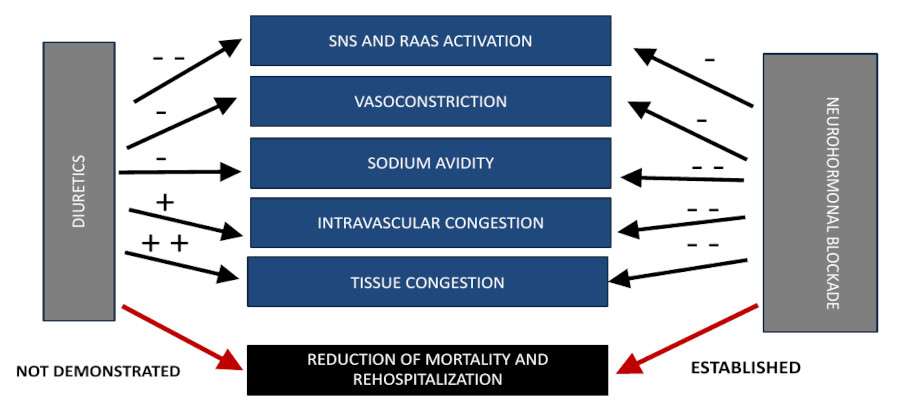
The message is clear: it is not enough to "remove water." Just as in myocardial infarction we do not limit ourselves to treating pain, in HF we should not be satisfied with treating edema. The future of treatment for decompensated HF is moving toward integrating decongestion as a necessary goal, but subordinate to a strategy that prioritizes intervention on pathophysiology. In this way, we can achieve more lasting control, with fewer events and a better prognosis. (Figure)

Figure. Mechanisms

of action and effects of diuretic treatment versus neurohormonal blockade

1850-3748-rac-93-05-386-gf1.gif 

RAAS: renin angiotensin aldosterone system; SNS: sympathetic nervous system


REFERENCES

1. Felker GM, Lee KL, Bull DA, Redfield MM, Stevenson LW, Goldsmith SR et al. Diuretic strategies in patients with acute decompensated heart failure. N Engl J Med 2011;364:797-805. https://doi.org/10.1056/NEJMoa1005419
2. Mullens W, Dauw J, Martens P, Verbrugge FH, Nijst P, Meekers E et al. ADVOR Study Group. Acetazolamide in Acute Decompensated Heart Failure with Volume Overload. N Engl J Med 2022;387:1185-95. https://doi.org/10.1056/NEJMoa2203094
3. Trullàs JC, Morales-Rull JL, Casado J, Carrera-Izquierdo M, Sánchez-Marteles M, Conde-Martel A. CLOROTIC trial investigators. Combining loop with thiazide diuretics for decompensated heart failure: the CLOROTIC trial. Eur Heart J 2023; 44:411-21. https://doi.org/10.1093/eurheartj/ehac689
4. Bart BA, Goldsmith SR, Lee KL, Givertz MM, O’Connor CM, Bull DA et al. Heart Failure Clinical Research Network. Ultrafiltration in decompensated heart failure with cardiorenal syndrome. N Engl J Med 2012;367: 2296-304. [https://doi.org/10.1056/NEJMoa1210357
5. Ter Maaten JM, Beldhuis IE, Van der Meer P, Krikken JA, Coster JE, Nieuwland W. Natriuresis-guided therapy in acute heart failure: rationale and design of the Pragmatic Urinary Sodium-based treatment algoritHm in Acute Heart Failure (PUSH-AHF) trial. Eur J Heart Fail 2022; 2:385-92. https://doi.org/10.1002/ejhf.2385
6. Dauw J, Charaya K, Lelonek M, Zegri-Reiriz I, Nasr S, ParedesPaucar CP. Protocolized Natriuresis-Guided Decongestion Improves Diuretic Response: The Multicenter ENACT-HF Study. Circ Heart Fail 2024;17:e011105. https://doi.org/10.1161/CIRCHEARTFAILURE.124.011695
7. Biegus J, Cotter G, Metra M, Ponikowski P. Decongestion in acute heart failure: Is it time to change diuretic-centred paradigm? Eur J Heart Fail 2024;26:2094-106. https://doi.org/10.1002/ejhf.3423
8. Mebazaa A, Davison B, Chioncel O, Cohen-Solal A, Diaz R, Filippatos G et al. Safety, tolerability and efficacy of up-titration of guidelinedirected medical therapies for acute heart failure (STRONG-HF): a multinational, open-label, randomised, trial. Lancet 2022;400:193852. https://doi.org/10.1016/S0140-6736(22)02076-1
9. Biegus J, Voors AA, Collins SP, Kosiborod MN, Teerlink JR, Angermann CE et al. Impact of empagliflozin on decongestion in acute heart failure: the EMPULSE trial. Eur Heart J 2023;44:41-50. https://doi.org/10.1093/eurheartj/ehac530
10. Velazquez EJ, Morrow DA, DeVore AD, Duffy CI, Ambrosy AP, McCague K et al. PIONEER-HF Investigators. Angiotensin-Neprilysin Inhibition in Acute Decompensated Heart Failure. N Engl J Med 2019;380:539-48. https://doi.org/10.1056/NEJMoa1812851
11. Nouhravesh N, Cyr D, Hernandez AF, Morrow DA, Velazquez EJ, Ward J. In-Hospital or Out-of-Hospital Initiation of Sacubitril/ Valsartan Versus Valsartan in Patients With Mildly Reduced or Preserved Ejection Fraction After A Worsening Heart Failure Event: The PARAGLIDE-HF Trial. J Am Heart Assoc 2025;14:e037899. https://doi.org/10.1161/JAHA.124.037899


HTML generado desde un xml-jats a través de la plantilla jats-rac.xsl  por  RevisCiencia.  El motor utilizado es Apache Software Foundation (Xalan XSLTC).