Pablo Corral1 MTSAC, Augusto Lavalle Cobo2 MTSAC
1 Instituto de Clínica Médica, Mar del Plata
2 Servicio de Cardiología, Sanatorio Otamendi, CABA. Argentina
Address for reprints: Pablo Corral. Rawson 1006, Mar del Plata. Argentina. drpablocorral@gmail.com
Rev Argent Car diol 2024;92:172-174. http://dx.doi.org/10.7775/rac.v92.i2.20477
Atherosclerosis can be defined as a chronic and progressive disease of the elastic arteries, characterized by the accumulation and retention of cholesterol in apolipoprotein B (ApoB) containing lipoproteins, mainly low-density lipoproteins, in the subendothelial space of these arteries. This concept seems so simple that Jan Borén and Kevin Jon Williams chose “a triumph of simplicity” as part of the title of an interesting review that describes the aforementioned. (1) Accordingly, William Clifford Roberts, modifying one of the phrases that brought Bill Clinton to the presidency of the United States at the beginning of the last decade of the 20th century, titled an editorial “It's Cholesterol, Stupid” in which he used four arguments to explain the causal role of cholesterol associated with low-density lipoproteins (LDL-C) in atherosclerosis. (2) In his review, Borén claims that it is a fact, not a hypothesis, that elevated cholesterol levels transported by lipoproteins with Apo B have a causal role in the genesis of atherosclerosis, and that lowering LDL-C also reduces the risk of cardiovascular events. Similarly, Clifford Roberts implies something similar when he quotes the word cholesterol “hypothesis” in the development of atherosclerosis.
This view of atherosclerosis is not universally accepted, it has its detractors, and this has motivated the publication of new studies, which seem to contribute to Jan Borén's “triumph of simplicity”.
Along these lines, a study published in JAMA, some months ago, adds to the body of evidence that for years has supported the causal role of LDL-C in the development of atherosclerotic cardiovascular disease (ASCVD). This interesting study analyzed the impact on a group of people with variations in two genes (APOB -apolipoprotein B- and PCSK9 –proprotein convertase subtilisin/kexin type 9) related to lipid metabolism, more precisely in reference to LDL-C levels. (3)
For this analysis, two large databases were considered (the National Heart, Lung, and Blood Institute -NHLBI- and the UK Biobank), with a total number of 209 537 analyzed individuals. (3)
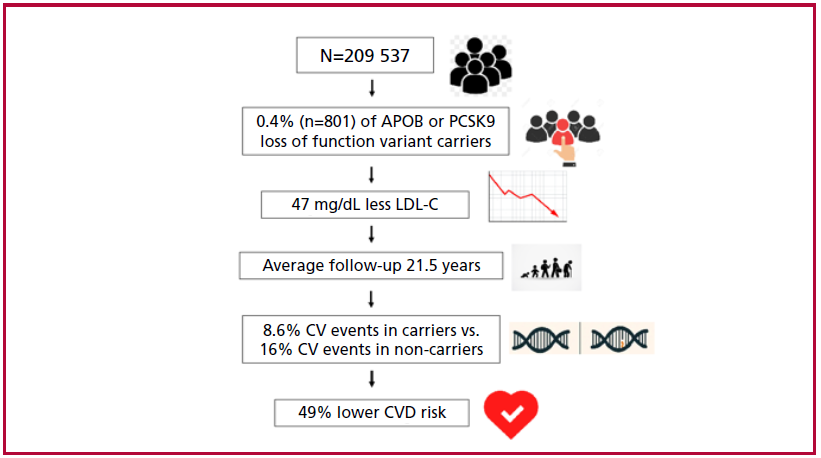
The analysis found in 0.4% of participants (n=801) a variant or mutation in the APOB or PCSK9 genes, associated with a decrease in the LDL-C level (47 mg/dL on average) compared with individuals without the genetic variant. Carriers of the genetic variant had an average of 80 mg/dL LDL-C, whereas non-carriers had an average of 128 mg/dL LDL-C. After a mean follow-up of 21.5 years, the incidence of coronary events reported was 8.6% in mutation carriers and 16% in non-carriers, which corresponds to a reduction of 49% in the adjusted risk of developing coronary heart disease. Interestingly, this result was observed despite an 8-fold greater use of statins and other lipid-lowering agents in the group not carrying the variants. (3) (Figure)
This finding is in line with previous studies of similar characteristics and design, which analyzed the impact of having a genetic variant associated with lower levels of LDL-C and the benefit in terms of decreased risk of atherosclerotic cardiovascular events. (4-6)
When we refer to the consistency of studies and scientific evidence, we observe that once again science shows us the preponderant and central role of LDL-C in the genesis and progression of ASCVD, which unfortunately continues to be the first cause of morbidity and mortality in Argentina and across the world. (7)
Fig. 1. Prognostic impact of a genetic variant associated with LDL-C decrease.
CVD: cardiovascular disease
From the first purely epidemiological studies, through genetic evidence (Mendelian randomizationstudies and genetic disorders of lipid metabolism) and finally the evidence derived from pharmacological intervention, science has shown us concordance, until now irrefutable, of this causal association between LDL-C and CVD of atherosclerotic origin. And it is the accumulated atherogenic load of LDL-C over the years (mg/dL/years) that determines the risk of suffering from atherosclerosis, which is difficult to observe when it is <5000 mg/dL/years. (8) For more than five years now, a reduction in the risk of cardiovascular events in studies with non-statin drugs such as ezetimibe, PCSK9 inhibitors and recently bempedoic acid has been found in pharmacological intervention studies. This last study included a population of patients at high cardiovascular risk but without established cardiovascular disease, with partial or total intolerance to statins. A benefit was observed in a proportion similar to that expected for equivalent reductions in LDL-C levels with statins. (9-12) Once again this reinforces that, regardless of the pleiotropic effect that each pharmacological group may have, the final common pathway responsible for most of the benefit is explained by the reduction of plasma levels of LDL-C and ApoB.
The benefit then of being aggressive in terms of beginning lipid-lowering therapy (the sooner, the better) and in terms of intensity (the lower, the better) is evidenced again in the observational study that we present, with an unquestionable methodology and design, and with clear implications when assessing the potential beneficial effect of reducing LDL-C levels in our patients. (3)
The above mentioned clearly adds to the basic and elementary recommendation of adopting a healthy lifestyle in which we can include an adequate diet, systematic physical activity, avoiding smoking and maintaining a good rest, among other actions. The synergy of these two strategies clearly has the power to modify the natural course of ASCVD and in this way combat the number one cause of morbidity and mortality in our country and worldwide. (13)
Conflicts of interest
None declared.
(See authors' conflict of interests forms on the web).
https://creativecommons.org/licenses/by-nc-sa/4.0/

©Revista Argentina de Cardiología
BIBLIOGRAFÍA
- Borén J, Williams KJ. The central role of arterial retention of cholesterol-rich apolipoprotein-B-containing lipoproteins in the pathogenesis of atherosclerosis: a triumph of simplicity. Curr Opin Lipidol. 2016;27:473-83. https://doi.org/10.1097/MOL.0000000000000330
- Roberts WC. It's the cholesterol, stupid! Am J Cardiol. 2010;106:1364-6. https://doi.org/10.1016/j.amjcard.2010.09.022
- Dron JS, Patel AP, Zhang Y, Jurgens SJ, Maamari DJ, Wang M, et al. Association of Rare Protein-Truncating DNA Variants in APOB or PCSK9 With Low-density Lipoprotein Cholesterol Level and Risk of Coronary Heart Disease. JAMA Cardiol. 2023;8:258-67. https://doi.org/10.1001/jamacardio.2022.5271
- Cohen JC, Boerwinkle E, Mosley TH Jr, Hobbs HH. Sequence variations in PCSK9, low LDL, and protection against coronary heart disease. N Engl J Med. 2006;354:1264-72. https://doi.org/10.1056/NEJMoa054013.
- Peloso GM, Nomura A, Khera AV, Chaffin M, Won HH, Ardissino D, et al. Rare Protein-Truncating Variants in APOB, Lower Low- Density Lipoprotein Cholesterol, and Protection Against Coronary Heart Disease. Circ Genom Precis Med. 2019;12:e002376. https://doi.org/10.1161/CIRCGEN.118.002376
- Kent ST, Rosenson RS, Avery CL, Chen YI, Correa A, Cummings SR, et al. PCSK9 Loss-of-Function Variants, Low-Density Lipoprotein Cholesterol, and Risk of Coronary Heart Disease and Stroke: Data From 9 Studies of Blacks and Whites. Circ Cardiovasc Genet. 2017;10:e001632. https://doi.org/10.1161/CIRCGENETICS.116.001632
- Ference BA, Ginsberg HN, Graham I, Ray KK, Packard CJ, Bruckert E, et al. Low-density lipoproteins cause atherosclerotic cardiovascular disease. 1. Evidence from genetic, epidemiologic, and clinical studies. A consensus statement from the European Atherosclerosis Society Consensus Panel. Eur Heart J. 2017;38:2459-72. https://doi.org/10.1093/eurheartj/ehx144
- Domanski MJ, Tian X, Wu CO, Reis JP, Dey AK, Gu Y, et al. Time Course of LDL Cholesterol Exposure and Cardiovascular Disease Event Risk. J Am Coll Cardiol. 2020;76:1507-16. https://doi.org/10.1016/j.jacc.2020.07.059
- Cannon CP, Blazing MA, Giugliano RP, McCagg A, White JA, Theroux P, et al; IMPROVE-IT Investigators. Ezetimibe Added to Statin Therapy after Acute Coronary Syndromes. N Engl J Med. 2015;372:2387-97. https://doi.org/10.1056/NEJMoa1410489
- Sabatine MS, Giugliano RP, Keech AC, Honarpour N, Wiviott SD, Murphy SA, et al; FOURIER Steering Committee and Investigators. Evolocumab and Clinical Outcomes in Patients with Cardiovascular Disease. N Engl J Med. 2017;376:1713-22. https://doi.org/10.1056/NEJMoa1615664
- Schwartz GG, Steg PG, Szarek M, Bhatt DL, Bittner VA, Diaz R, et al; ODYSSEY OUTCOMES Committees and Investigators. Alirocumab and Cardiovascular Outcomes after Acute Coronary Syndrome. N Engl J Med. 2018 Nov 29;379(22):2097-2107. https://doi.org/10.1056/NEJMoa1801174
- Nissen SE, Lincoff AM, Brennan D, Ray KK, Mason D, Kastelein JJP, et al; CLEAR Outcomes Investigators. Bempedoic Acid and Cardiovascular Outcomes in Statin-Intolerant Patients. N Engl J Med. 2023;388:1353-64. https://doi.org/10.1056/NEJMoa2215024
- Visseren FLJ, Mach F, Smulders YM, Carballo D, Koskinas KC, Bäck M, et al; ESC National Cardiac Societies; ESC Scientific Document Group. 2021 ESC Guidelines on cardiovascular disease prevention in clinical practice. Eur Heart J. 2021;42:3227-37. https://doi.org/10.1093/eurheartj/ehab484